
A family home a few streets from the lake
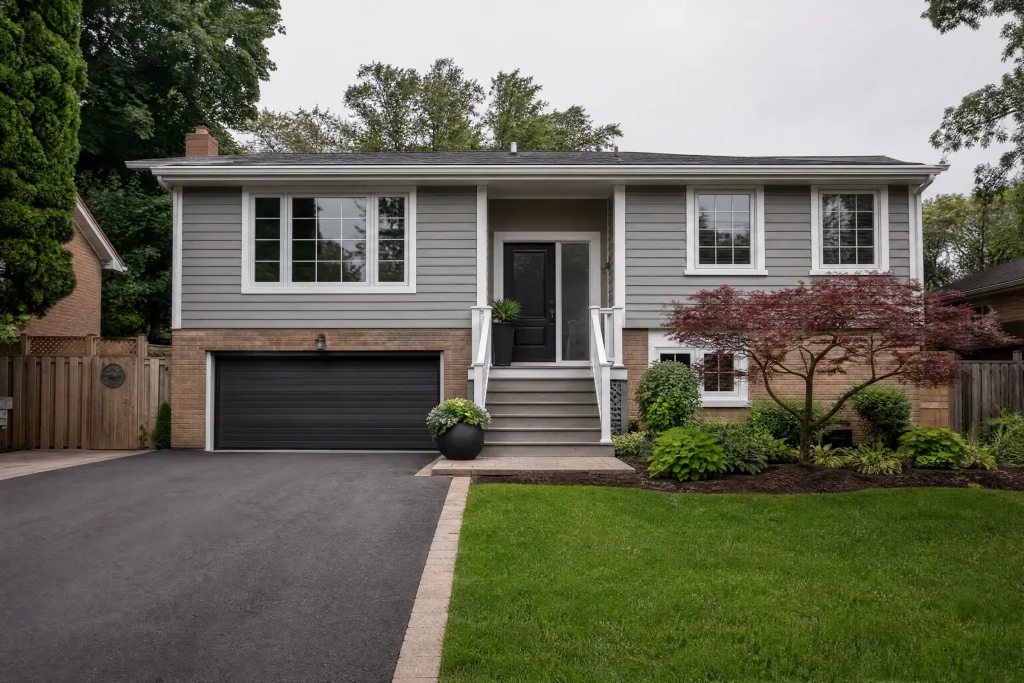
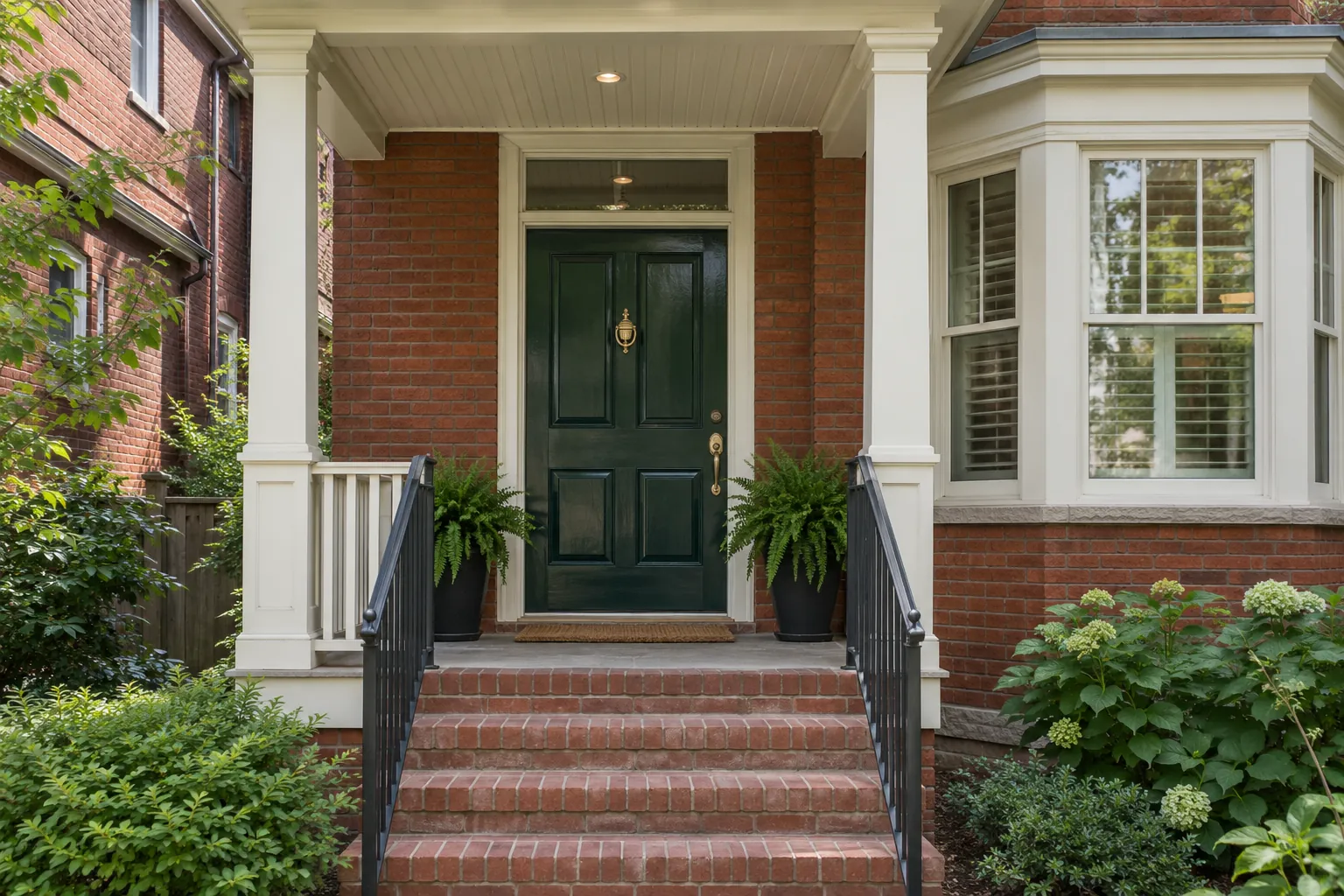
Much of Ajax behind its Lake Ontario waterfront filled in with subdivisions between the 1970s and the 1990s. This house is one of the later ones: a two-storey with beige siding, a front porch carried on red-brick piers and white columns, and a fibreglass front door with a moulded woodgrain and a small arched glass lite near the top. It sits a few streets from the shore, close enough that the wind off the lake is part of daily life.
The door had come from the factory ready to stain, and it had been stained a medium oak tone with a clear coat over it. In front of it hung an aluminum storm door with a full glass panel. The owners wanted the stained look gone and a near-black door in its place, which matched the brick and columns better and suited the hardware they had already bought.
The storm door had done the damage
When the storm door came open, the reason for the failure was obvious. A full-glass storm door on a sunny wall works like a small greenhouse: sunlight passes through the glass and heats the air trapped against the entry door. On this door, the clear coat had cracked across the lower panels, curled at the edges and lifted in thin, brittle sheets. Where the clear was gone, the stain underneath had faded from oak to a washed-out orange.
The upper part of the door, shaded by the storm door’s frame and the porch roof, still had clear coat that was firmly bonded. So the slab was half peeling and half sound, and the two halves needed different handling. The owners decided not to put the storm door back, which also removed the heat concern that comes with a dark colour behind glass.
The details that made it slower
- The arched lite had a plastic frame moulded around it, which had yellowed and would not hold paint without the right primer.
- Old furniture wax had been used on the door at some point to brighten the stain, and wax blocks paint from bonding.
- Morning dew off the lake left the porch damp until the sun had been on it for a while, which set the hours for each coat.
Prep and protection
The porch
We took the storm door off its hinges and carried it to the garage with its hardware taped to the frame. Drop sheets covered the porch floor and steps, and the bases of the white columns and the brick piers next to the door were wrapped in plastic. The old brass knob and deadbolt stayed on, masked with tape, while the primer went on, and came off before the finish coats, since the owners were replacing them with a matte black lever handleset.
The slab
- The peeling clear coat was lifted with plastic scrapers, which take off loose material without scratching the fibreglass skin. On the lower panels it came away almost entirely.
- Where clear coat was still firmly stuck, it stayed. Its edges were feathered with fine sanding sponges so there would be no visible step between the bonded clear and the bare stained areas once painted.
- The whole slab was cleaned with a solvent cleaner to remove the old wax, then wiped again with fresh rags until they came away clean. Skipping this step would have left the new paint lifting in the same places the wax had been.
- Every surface was dulled with an extra-fine sanding sponge, keeping light pressure so the woodgrain texture survived.
The lite frame
The plastic around the arched glass was cleaned, scuffed with a fine sponge and masked tight to the glass. Plastic trim like this needs a primer rated for it, or paint will scratch off with a fingernail. The primer we used covers fibreglass, plastic and old finishes, so one product could go over the slab and the lite frame alike.
Priming
A stain-sealing bonding primer went over the entire slab, edges included, and the lite frame. It does two jobs here: it grips the mix of fibreglass, bonded clear and stained surfaces, and it seals the old stain so it cannot react with or bleed into the new paint. The jamb and brickmould were caulked where the old caulk had split, and bare spots on the wood were primed.
Brushing the finish coats
The door stayed in its frame and was painted by brush, working with the woodgrain direction moulded into each part. Panel profiles went first, then the panels, then rails and stiles in long strokes from end to end, so each surface was finished before its edges began to dry. The plastic lite frame was painted with a smaller brush, carefully, since a heavy coat there would sag.
Two coats of exterior acrylic door enamel in satin went onto the slab, the edges and the lite frame. Each coat started only after the dew had dried off the porch and was finished early enough in the afternoon to dry before the evening damp came in off the lake. The second coat waited until the manufacturer’s stated recoat interval was up. The jamb and brickmould took two coats of white satin trim paint, so the black door sits inside a crisp white outline that matches the porch columns.
The door was propped open while each coat dried to the touch and the weatherstripping was wiped down before it closed for the evening, so the fresh finish would not stick to the seals.
Settling on blue-black
The owners knew they wanted something close to black, but had not decided which. Our free colour consultation brought sample pots of a jet black, a charcoal and a blue-black, a very dark navy that reads as black from a distance. We painted each one on primed sample boards so the owners could set them against the red brick piers and white columns, looking first in the bright morning light, then again in the evening.
Jet black looked flat and slightly harsh beside the beige siding. The charcoal seemed grey next to the brick. The blue-black held its depth in both lights and showed a hint of navy only when the sun was directly on it, which the owners liked. Satin was chosen because it softens fingerprints and is easy to wipe after a wet day on the porch.
Cleanup through the job
At the close of each day the drop sheets were folded, sanding dust and the curled flakes of clear coat were swept and bagged, rags soaked with solvent cleaner were sealed in a metal can for disposal, and the porch was left clear for the family to use. After the last coat, the plastic came off the columns and piers, the new matte black lever handleset was installed, and the glass of the arched lite was cleaned.
The finished door and its care
The door now reads as black from the street, with the woodgrain texture still visible up close and the arched lite framed in the same colour. The white brickmould and columns give it a clean frame, and the red brick piers sit warmly on either side.
- Leave the storm door off. A dark door behind glass on a sunny wall heats up, which is what destroyed the original finish.
- For cleaning, a soft sponge and soapy water is enough; skip wax and furniture polish, which will dull satin and spoil future repainting.
- Check the bottom edge and the lite frame each spring for chips or cracks.
- Labelled touch-up cans of the blue-black and the white trim paint are in the garage beside the storm door.
Why this suits homes near the Ajax waterfront
Sun, wind and morning damp off the lake all work on an entry door near the shore, and storm doors, common on houses of this era, add trapped heat to the mix. Converting a tired stained door to paint is often more practical than restaining fibreglass that has lost its clear coat. Our door refinishing service covers both, and the timing is planned around dry days and dew. There is more about the town’s postwar houses, subdivisions and newer streets on the Ajax page, and we work across the rest of Durham Region too. If your door is peeling behind a storm door, send us a message and we will itemize the removal, primer and finish coats in a written quote.