
DRYWALL
REPAIRS patched, primed and ready for paint

- Free quotes
- Itemized written quote
- Since 2010
- Open 7 days
Holes, cracks, dented corners and leak marks are cut back, patched, sanded and primed so the repair disappears under the new coat. Each patch can be left primed or painted to finish.
Walls made whole again
Drywall repairs in Toronto that vanish under the paint
Drywall repair covers the damage that builds up in any lived-in house: nail pops along the ceiling line, screw and anchor holes left by shelves and televisions, the round dent a doorknob punches into the wall behind it, cracks that open above doors and windows, crushed outside corners, and sections stained or softened by a leak. All Painting handles each of these, whether it is one dent or a list of repairs across the house. Small holes, large openings, water damage, cracks and corners each call for a different fix, and the finished wall should show none of them.
Most calls come from people at a turning point. Some are getting ready to sell and want the scuffed hallway and the old picture-hook holes dealt with before listing photos. Others have just had an electrician, plumber or kitchen installer through, and the walls are full of access holes. Landlords between tenants, parents whose teenagers have moved out, and owners recovering from a burst pipe or an ice-dam leak ask for the same thing: walls that look untouched. Condo owners often need repairs finished before a move-out inspection by building management.
A good repair is one you cannot find. When you stand at the end of the room and look along the wall toward a window, the low light should pass over the patch without catching a ridge, a dip or a change in texture. Corners should run straight from floor to ceiling. The repaired area should take paint at the same rate as the wall around it, so there is no dull halo after the finish coats. On textured ceilings, the pattern should carry through the patch without a visible edge.
Planning starts with the cause. A crack over a door frame that keeps returning needs tape, not just filler, and a water stain needs proof that the leak has stopped before anything is cut out. We look at each spot, note its size and what made it, and decide whether it gets filled, patched, retaped or replaced with new board. Your itemized written quote lists every repair and says whether the area is left primed or painted to finish, and before the first repair visit you know who is coming.

Small holes and nail pops
Nail pops are pulled tight with a drywall screw driven beside the old fastener, then covered. Screw holes, anchor holes and doorknob dents are filled in thin layers, sanded level with the surrounding board and spot-primed so they stop showing once the wall is painted.
Large holes and cut-outs
Openings left by plumbing access, electrical work or a removed light fixture are squared off, backed with wood strips where there is no stud, and fitted with a new piece of drywall. Seams are taped, filled in several coats and feathered wide into the wall.
Cracks and damaged corners
Cracks along seams and above door and window frames are opened, cleaned out and covered with fresh tape so they are less likely to come back. Crushed or dented outside corners get new corner bead where the old metal has bent, then are filled to a straight edge.
Water damage and ceilings
Once the leak is fixed and the board is dry, soft or crumbling sections are cut out and replaced. Brown rings are sealed with a stain-blocking primer. Ceiling patches are finished smooth or textured to match the area around them, so the repair does not catch the light.

How each kind of drywall repair is done
For small damage the work is about patience rather than material. Loose paper around a hole is trimmed back so it cannot lift under the filler. The first coat of lightweight compound goes in with a narrow knife and is left to dry fully, because compound shrinks as it dries and a single heavy fill leaves a dip. A second, wider coat levels it, and a light sanding brings it flush. Each spot is wiped free of dust and given primer, which keeps the patch from flashing through the paint.
Larger openings start with a clean cut. The damaged area is marked out as a rectangle, cut back to sound board and checked for wiring or pipes behind it. Backing is fixed in place where there is no stud to screw into, and a new drywall piece is fastened in. The joints get paper or mesh tape bedded in setting compound, followed by two or three finishing coats spread progressively wider so the repair tapers into the wall. Water-damaged board is replaced the same way, after a moisture check.
Cracks are widened slightly with a knife so the filler has something to grip, then taped and finished like a seam. Bent corner bead is cut out and replaced with new bead set straight with a level before it is coated. Ceilings are worked from a ladder or rolling platform, with the patch finished smooth or textured to match the surrounding surface. Older houses with plaster walls get materials suited to plaster, including a bonding agent where needed, so the repair holds to the old surface.
Reviews
What clients say
Why hire professionals
Why hand drywall repairs to a painting company
A patch looks simple until the paint goes on. Raking light, mismatched texture and unprimed compound reveal shortcuts quickly. A painter who also does the repair controls every layer, from the first fill to the last finish coat, so the wall reads as one surface.
Repairs planned for the paint
We repair with the finish in mind. Patches are feathered and primed to the standard the final sheen demands, since a satin wall shows far more than a flat ceiling does.
One booking instead of two trades
You do not need to line up a drywaller and then a painter and juggle drying time between them. Repair, primer and paint are planned together in one written quote.
Dust kept to a minimum
Floors and furniture are covered, sanding is kept light with fine abrasives, and dust is vacuumed up so the room is left clean and usable before we head out after every visit.
Causes looked at, not just symptoms
A crack that keeps opening or a stain that spreads points to movement or moisture. We note what we see and tell you when another trade should look at it first.
Colour matched or wall repainted
Touching up a single patch rarely blends. We advise when repainting the whole wall corner to corner gives a cleaner result, and offer a free colour consultation with sample pots.

Our process
How a drywall repair job runs
Drywall compound and primer need drying time between coats, so a repair is planned in stages rather than rushed in one visit. Here is the order we follow from the first look to the final check.
Look and measure
We look at each damaged spot, measure it and note what caused it. For a handful of small holes, clear photos sent by email are often enough to prepare a quote without a visit.
Written quote
You receive a free, itemized written quote listing every repair, the method for each one and whether the area will be left primed or painted to finish, so nothing is left to guesswork.
Room protection
Furniture is moved back from the wall and covered, drop sheets go down over the floors, and outlet covers near the repair are removed so filler and dust stay where they belong.
Repair in stages
Each area is patched, taped and filled in thin coats, with drying time between them, then sanded smooth and primed. Deeper repairs and new board need more coats, so they can span more than one visit.
Paint and final check
Where the wall is being painted, at least two finish coats follow the primer. We then walk the room with you, checking each repair in the light, before the drop sheets come up.
Ready to start?
Call (416) 710-4224 or send a few details and photos for a free, itemized quote.
Preparation
Preparing a room for drywall repair work
Clearing the wall
Pictures, shelves, curtains and anything hanging near the repair are taken down, and furniture is pulled toward the centre of the room. You are welcome to pack away fragile items yourself; we move and cover the larger pieces so the wall is fully reachable.
Checking for moisture
Before any water-damaged area is opened, we check that the leak has been fixed and that the board is dry. Repairing over damp drywall traps moisture and lets stains return, so a wet ceiling waits until it has dried out completely.
Cutting back to sound board
Torn paper, crumbling gypsum and loose tape are removed until only firm material remains. Patching over a weak edge is the most common reason a repair cracks or bulges later, so this step is never skipped, even on small holes.
Controlling dust
Drop sheets cover floors and furniture, doorways can be screened off with plastic, and sanding is done with fine abrasives and a light hand. Dust is vacuumed rather than swept, so it does not drift into the rest of the house.
Priming the patch
Bare joint compound soaks up paint faster than the painted wall around it. Every repair gets a coat of primer, and stained areas get a stain-blocking primer, so the finish coats dry to an even sheen across the whole surface.


Products and finishes
Lightweight and setting compounds
Premixed lightweight compound suits small holes and finishing coats because it sands easily. Setting-type compound, mixed from powder, hardens by chemical reaction rather than by drying, so it suits deep fills, the first coat over tape and repairs that must be built up without sagging.
Paper and mesh tape
Paper tape bedded in compound gives the strongest joint along seams and inside corners. Self-adhesive mesh tape works well over patches and cracks when it is covered with a setting compound. The choice depends on where the repair sits and how much movement it is likely to see.
Primers and stain blockers
A drywall primer seals fresh compound and new paper so paint goes on evenly. Over water marks, smoke stains or marker, a stain-blocking primer stops the discolouration from bleeding into the finish. Zero‑VOC and low-odour primers are available for bedrooms and occupied homes.
Finish paint and sheen
Patched walls are painted with an interior latex in the sheen already on the wall, or in a new one if you are changing it. Flat and matte finishes hide repairs well; satin and semi-gloss show more of the surface, so they need extra care in the finishing coats.
Service areas
Where we repair drywall
In Toronto, drywall work ranges from century homes with plaster and lath to downtown condos with smooth, thin partition walls. Older semis in the east and west ends often have plaster patched with drywall during past renovations, which leaves mismatched surfaces that need careful blending. Condo units tend to need small repairs before a sale or move-out, often booked around elevator reservations and building quiet periods. Basement apartments and finished lower levels see more dents and water marks than upstairs rooms, so they are a common source of calls.
Outside the city, the housing stock changes. Subdivision homes in Peel Region and York Region, in Mississauga and Markham for example, built in recent decades often show nail pops and seam cracks as framing lumber dries and settles. Homes in Halton Region, Oakville among them, often call after a basement finish or kitchen renovation leaves access holes behind. In Durham Region, newer builds and older bungalows both turn up corner damage and ceiling cracks. The method stays the same everywhere: find the cause, repair in stages, prime and paint.
Before you book
What the seasons and your building do to drywall
The swing between humid summers and dry, heated winters makes wood framing expand and shrink through the year. That movement is what pushes nail pops out of ceilings and opens hairline cracks at the corners of door and window frames, often in the first cold snap after the heating comes on. Repairs made in a stable indoor climate hold better, and taped repairs at stress points are less likely to reopen than filler alone. If a crack has opened and closed with the seasons before, we treat it as a moving joint.
Many leaks behind walls and ceilings here trace back to winter. Ice dams along the eaves push meltwater under shingles, frozen pipes in exterior walls split, and bathrooms above living rooms leak through worn grout or failed seals. The stain on the ceiling is usually the last thing to appear. A painter should not be the first call for an active leak: a roofer or plumber fixes the source, the area dries out, and then the damaged drywall can be cut out, replaced, primed and painted.
Condo repairs come with building rules. Many condominiums require contractors to check in with the management office, limit noisy work to set times, and need elevator bookings for materials. Sanding dust can set off smoke detectors in some suites, so detectors near the work are discussed with you before we start. For rental units and suites being sold, repairs can be planned around a move-out or listing date, as long as the drying time between coats is built into the schedule from the beginning.
- Confirm any leak behind a stain has been fixed and dried
- Walk each room in daylight and mark every hole and crack
- Decide whether repaired walls will be painted corner to corner
- Check condo rules on work times, noise and elevator bookings
- Clear shelves, pictures and fragile items from the work area

What affects the price of drywall repairs
The number of repairs and their size matter most, but they are not the whole story. A cluster of nail holes in one room takes less work than the same number spread across three floors. Water damage adds cutting, replacement board and stain-blocking primer. Ceiling patches take longer than wall patches because they are worked overhead, and matching a sprayed or stippled texture adds another step. Plaster walls need different materials and more careful blending than modern drywall.
The other big factor is what happens after the repair. Leaving patches primed for your own painting costs less than having the whole wall repainted, though repainting gives a more even result. Grouping several repairs into one visit makes good use of the time, since the drying gaps between coats can overlap. Our painting cost calculator offers a rough planning figure, and a few photos then get you a free, itemized written quote.
Price it before anyone visits
Pick the rooms and the work in our cost calculator for a ballpark range in about a minute.
Then ask for a free quote: written, itemized and free to change before work starts.
What a repaint changes
Drag the handle, see the difference
A living room before and after: the patch marks and scuffs filled and sanded smooth, then two coats of a warm off-white. Slide to compare.

 Living room repaint
Projects
Recent drywall repair projects

- Drywall
- Scarborough
Basement drywall rebuilt after seepage in a West Hill bungalow
A basement rec room in West Hill, Scarborough: seepage-damaged drywall cut out and walls and ceiling rebuilt, then painted warm creamy white in eggshell.

- Drywall
- East York
Pape Village storey-and-a-half: wiring holes patched in plaster
A storey-and-a-half in Pape Village: wiring holes in plaster patched and seams blended, then bedrooms painted pale clay and light blue under warm white slopes.

- Drywall
- Brampton
Skylight stain and high ceiling skim coat in a Heart Lake home
A two-storey family room in Heart Lake, Brampton: skylight water ring sealed, failed seam retaped and the ceiling fully skimmed, then rolled in flat white.
Resources
Painting Guides and Resources
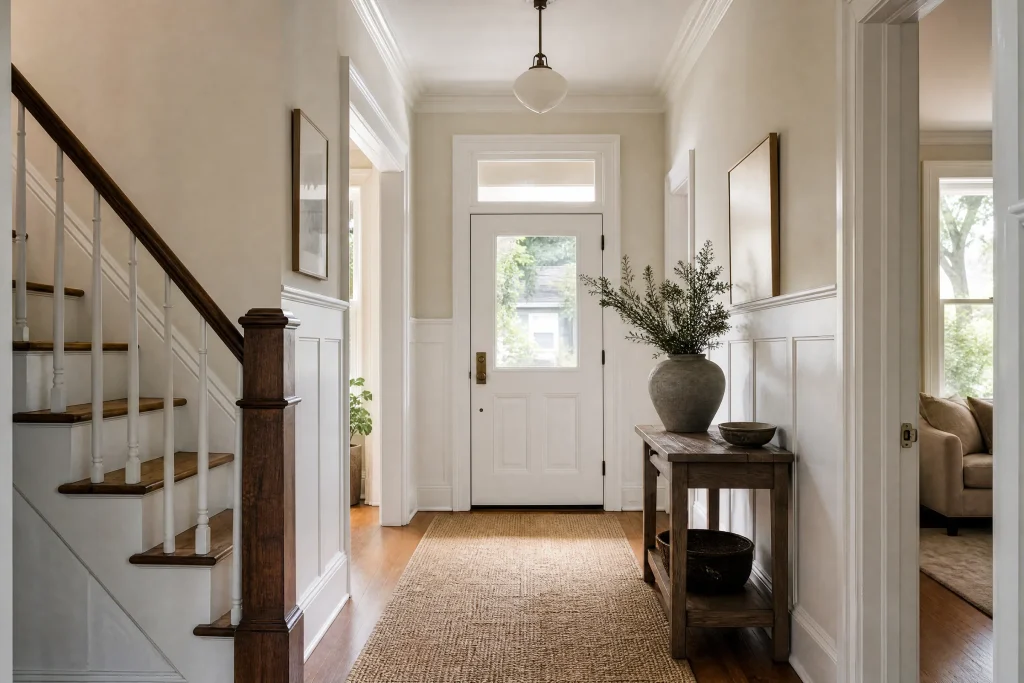
- Guide
Choosing paint sheen room by room
Matte, eggshell, satin or semi-gloss? How sheen changes the way a wall looks, cleans and wears, and which finish suits each room in the house.
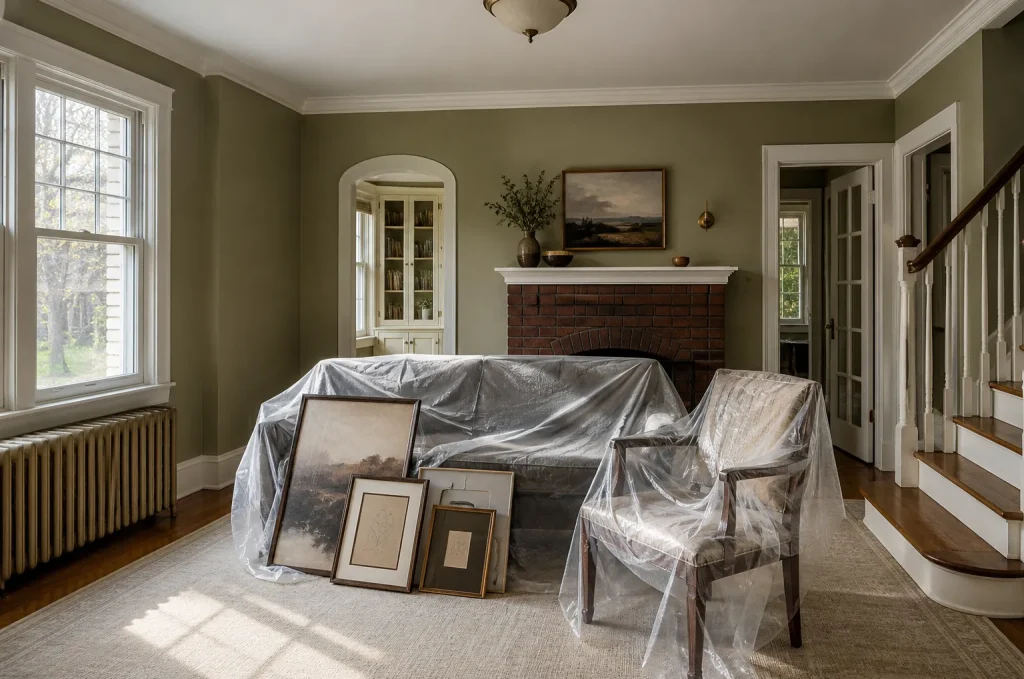
- Guide
How to prepare your home for painters: a checklist
A practical checklist for the weeks, days and morning before the painters arrive, inside and out, so the job starts on time and finishes without surprises.
Will the repair show once the wall is painted?
It should not. Repairs are built up in thin coats, feathered out well beyond the damaged area, sanded and primed, so the surface is level and absorbs paint at the same rate as the rest of the wall. The wall then gets at least two finish coats. Touching up only the patch with leftover paint is where most visible repairs come from, because older paint fades and the sheen rarely matches.
Can you repair water-damaged drywall and ceilings?
Yes, once the source has been dealt with. We look at the stain and the board, and if the leak is still active we will tell you whether a plumber or roofer is needed first. After the area has dried, soft or sagging board is cut out and replaced, the joints are taped and finished, and lingering brown rings are locked in under stain-blocking primer before painting.
Do you repair plaster walls as well as drywall?
Yes. Many older houses in the city still have plaster on lath, and it is repaired with materials made for plaster rather than standard joint compound alone. Cracks are opened and taped, loose sections are secured or replaced, and a bonding agent helps new material grip the old surface. Where earlier owners patched plaster with drywall, the joint between the two is blended so the change does not show.
Why do some repairs take more than one visit?
Joint compound has to dry before it can be sanded and recoated, and deep fills need several coats to stay level without shrinking back. Primer and paint add their own drying time. A few small holes can often be completed quickly, but a new piece of drywall or a water-damaged ceiling is normally spread over more than one visit. Your written quote sets out the plan so you know what to expect.
Can you match my ceiling texture?
In most cases, yes. Smooth ceilings are finished flat, and lightly textured, orange-peel and stippled ceilings are textured to blend with the surrounding surface before painting. Older popcorn ceilings are harder to match exactly, and some owners choose to have a larger area or the whole ceiling refinished instead. We look at the ceiling during the quote and explain which approach will give the most even look.
Why do nail pops keep coming back?
A nail pop happens when the framing behind the drywall shrinks or shifts and pushes the fastener head out. Filling over the old nail rarely lasts, because it keeps moving. We drive a drywall screw next to it to pull the board tight against the stud, set the old nail back, and fill both. Seasonal movement can still cause new pops elsewhere, especially in newer homes.
How should I prepare the room before you arrive?
Take down pictures, mirrors and shelves near the damaged areas, and put away small or fragile items. Larger furniture can stay; we move it away from the walls and cover it along with the floors. If pets or children use the room, a closed door helps while compound and primer dry. We clean up before leaving after every visit, so the room stays usable in between.
Which areas do you cover for drywall repairs?
We repair drywall in houses, condos and rental units all over the city, and in the Peel, York, Halton and Durham regions as well. Since 2010 we have been repairing and painting walls around the city, and the business is run from 18 King St E. Pricing a repair is free, and for a few small holes a set of clear photos is usually all we need.
Free quotes across the GTA
Get a quote for your drywall repairs
Send a few photos of the damage or book a visit, and you will get a free, itemized written quote that lists every repair and the finish planned for it.