
An all-oak staircase from the 1990s
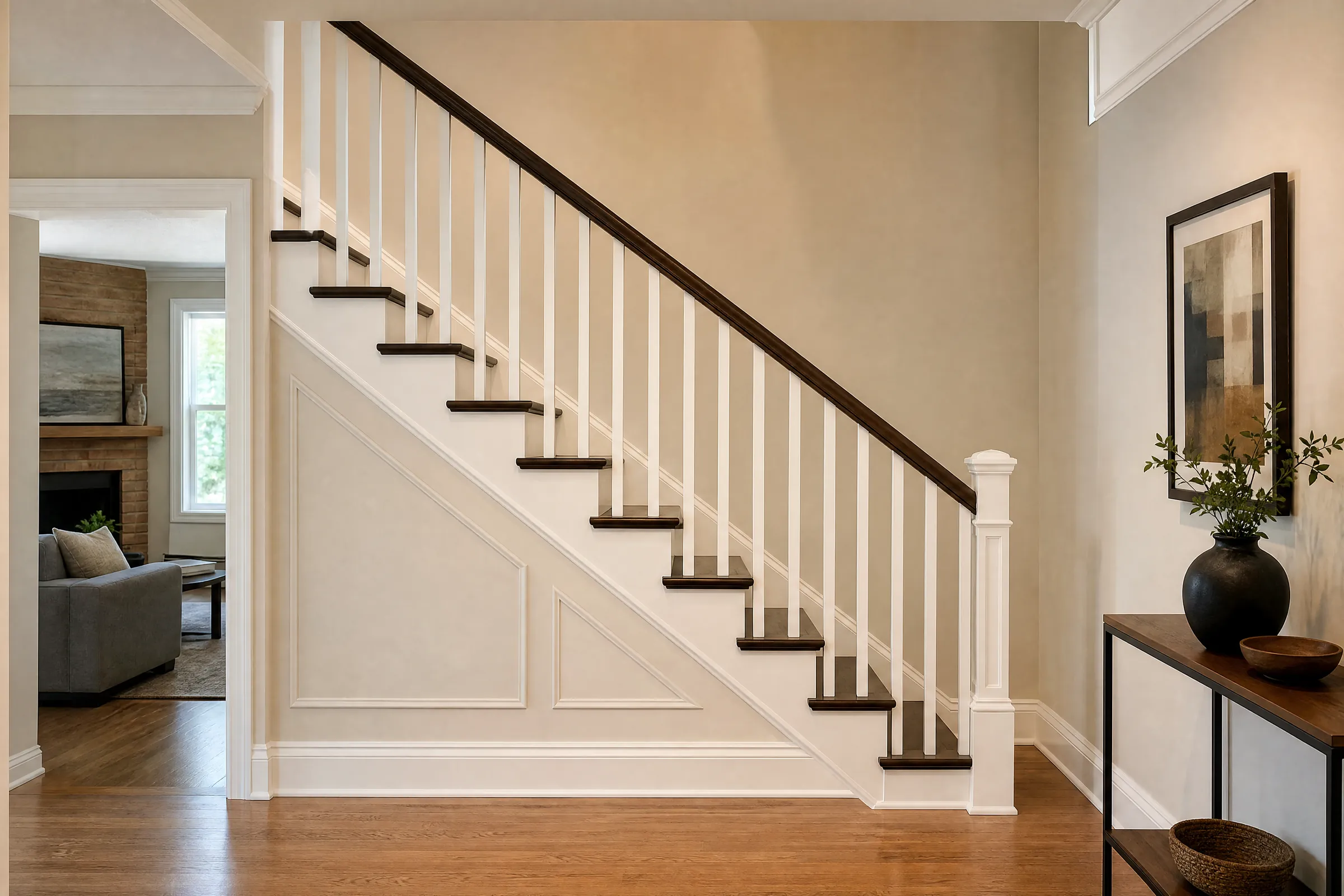
North of Highway 401, much of Ajax is made up of two-storey detached homes and townhouses, and many of the houses from the 1990s were finished with the same feature: a staircase done entirely in honey oak. This home was one of them. The stair runs up from the front hall with a short half-wall at the bottom, capped with oak, then turns at a landing. Treads, risers, skirt boards, the handrail, the newel posts and a long row of turned spindles were all oak, all with the original glossy finish that had slowly turned a deeper orange.
The owners had refinished the oak treads not long before and liked them. Everything else on the stair looked dated to them next to their newly painted white trim and doors. They asked us to paint the spindles, newels, handrail, risers, skirt boards and the half-wall cap white, and leave the treads alone.
Tannins, gloss and lots of turned spindles
The oak was in good condition, with a few dents in the newel posts at child height and some marks on the handrail from bags and keys. The challenge was not damage but the wood itself. Red oak is full of tannins, natural compounds that dissolve in water-based coatings and travel to the surface as tan or pinkish stains in white paint. The factory finish on the oak was also slick and glossy, and paint does not grip a hard clear coat unless it is properly dulled and primed.
The other challenge was the number of turned spindles. Each one has beads, coves and flat sections, and every curve has to be cleaned, sanded, primed and painted twice without runs. On a stair with this many spindles, the time goes into those details, and quality depends on patience rather than speed.
Getting the oak ready for paint
Protecting the treads and hallway
Because the treads were freshly refinished, we used delicate-surface tape along each tread where spindles, risers and skirt boards meet it, and covered each tread with paper. The front hall floor was covered with drop cloths over rosin paper. The half-wall and the bottom newel are right beside the front door, so we kept a clear path to it.
Cleaning and deglossing
- All the oak to be painted was washed with a degreasing cleaner to remove hand oils and household grime, especially on the rail and newel caps.
- A liquid deglosser was wiped on to soften the shine of the factory finish.
- Every surface was scuff-sanded with a fine sponge, following the shape of each spindle, then wiped clean with a damp cloth and left to dry.
- Dents in the newels were filled with a hard-setting filler and sanded flush.
Testing the primer first
Before committing to a primer, we primed a test spindle and the bottom of a riser with a waterborne tannin-blocking primer. By the next morning, faint tan spots had come through near the open grain at the base of the spindle. That told us this oak needed a stronger blocker, so the rest of the stair got an oil-based stain blocker instead, and the test areas were sanded and reprimed with it as well.
Handrail, joints and caulking
Red oak has a coarse, open grain that still shows through paint. On the spindles, that slight texture looks natural. On the handrail, where every hand feels it, we applied a second coat of primer and sanded it smooth once it had dried, which fills much of the grain. Joints where the skirt boards meet the wall, where risers meet treads and where the newels meet the half-wall were caulked with paintable acrylic caulk.
White enamel, coat by coat
All the primed surfaces took two coats of urethane-reinforced acrylic enamel in white semi-gloss, applied by brush. We worked from the top of the stair down, starting with the handrail and then the spindles, newels, risers and skirt boards, so drips would never land on finished work below. Each spindle was painted from the top down, with the brush loaded lightly to avoid runs in the coves. Between coats, we waited for the recoat time listed on the can, and lightly sanded with an extra-fine sponge to catch any dust nibs.
Semi-gloss was chosen for its wipeability. A busy household with children and a dog touches the newels, spindles and rail constantly, and semi-gloss enamel cleans more easily than satin. The urethane-reinforced formula also cures harder than a standard trim paint, which matters on the handrail and the newel caps.
The half-wall cap at the foot of the stair
The oak cap on the half-wall by the front door turned out to be the most used surface in the house after the handrail. Mail, keys and school bags land on it every day, and its top had fine scratches through the old finish. It was sanded a little harder than the rest, given the same double coat of primer as the rail and sanded flat, then finished with the two enamel coats. We used a wider brush on the flat top so it could be laid off in single, full-length strokes, which leaves no stop marks in a semi-gloss.
Why white, and why the rail went white too
At the free colour consultation, we compared several whites from sample pots on primed scrap pieces held against the oak treads and the existing white trim. The owners wanted the stair to match the newly painted doors and trim, so we matched that colour. The bigger decision was the handrail. Many owners keep the rail stained because it takes the most wear, and we laid out that option. The owners preferred a clean, all-white railing to match the trim, with the honey treads as the only wood on the stair. A white rail does show marks sooner, so the harder enamel and semi-gloss sheen were chosen with that in mind.
Daily routine in a family home
The household carried on around the work. We painted alternating sections of spindles so the stair could be used safely, and kept the bottom newel dry by the time children came home from school. Primer with stronger odour was applied with windows open, and a low-odour enamel was used for the finish coats. Brushes, rags and primer cans were packed into the garage each evening, and the hallway was swept and left clear.
Living with a white railing
- The enamel is dry to the touch quickly, but it keeps hardening for a while. Gentle use of the rail during that time helps prevent marks.
- Wipe the rail and newel caps with a damp cloth and a mild cleaner; avoid abrasive pads that dull semi-gloss.
- Small chips from bags or toys can be touched up with the labelled can of white we left; sand the edge lightly first.
- If tan spots ever show through the white, it is tannin bleed; spot-prime it with an oil-based stain blocker before touching up.
Why this suits Ajax homes
Two-storey homes built in the 1990s across Ajax often have exactly this kind of honey oak stair, and painting the oak white is one of the most common ways to update it without new parts. Testing the primer before starting is what keeps tannins from showing up later. We do the same careful prep on stairs across Durham Region.
Our team has been doing this kind of work in Toronto and the surrounding towns since 2010, and every painted part of a stair like this one ends with two or more finish coats. More about painting and staining stairs is on our staircase painting page. If you have an oak railing you would like painted, send us a message or a few photos, and we will provide an itemized written quote.