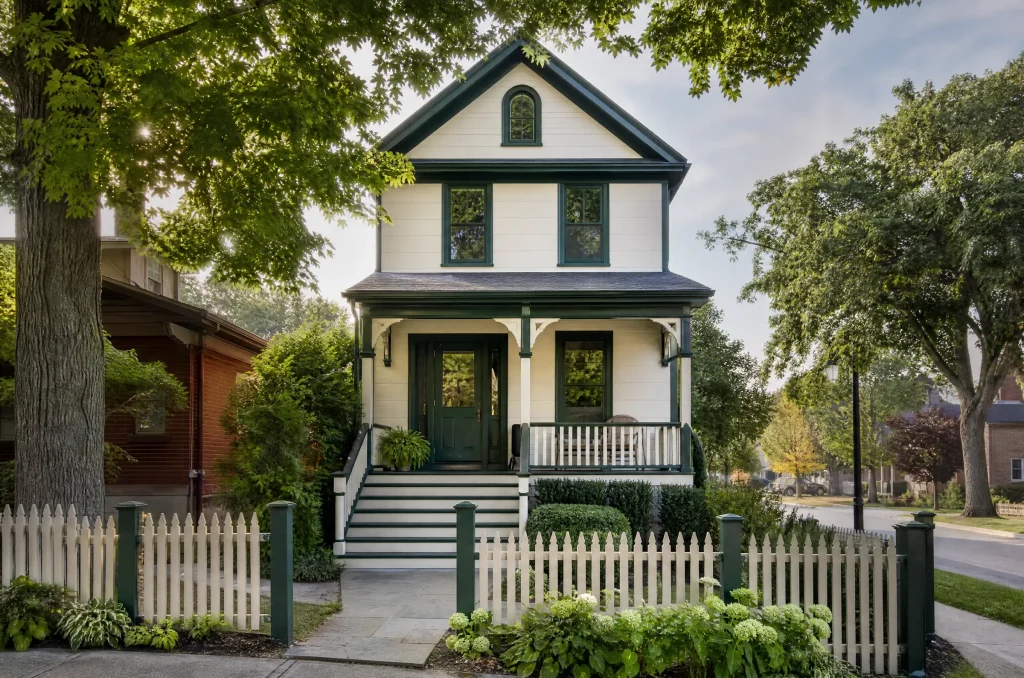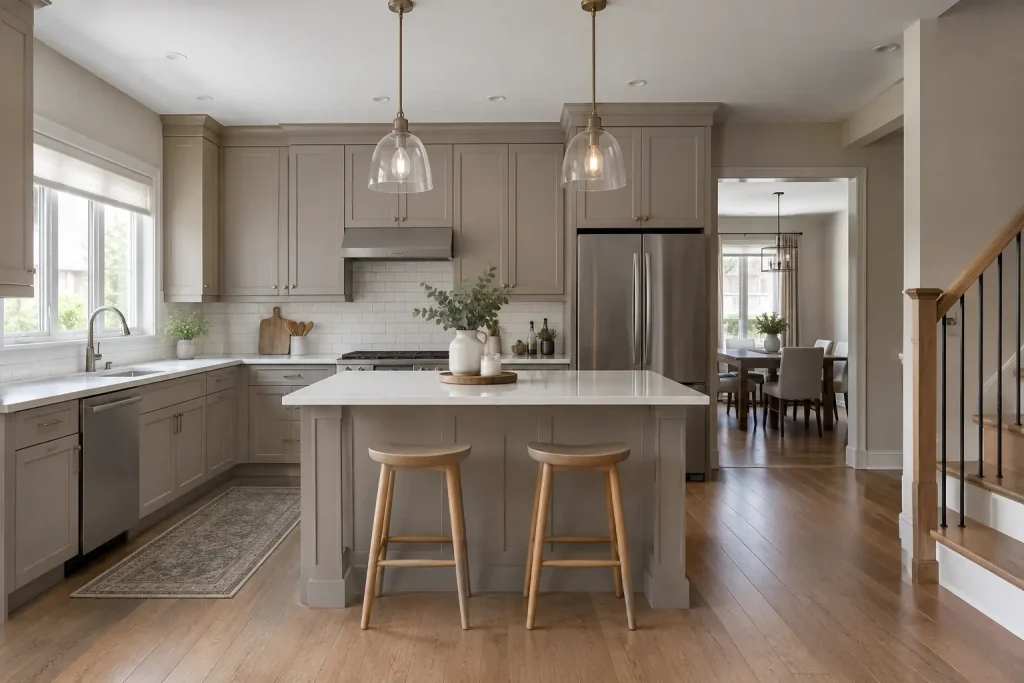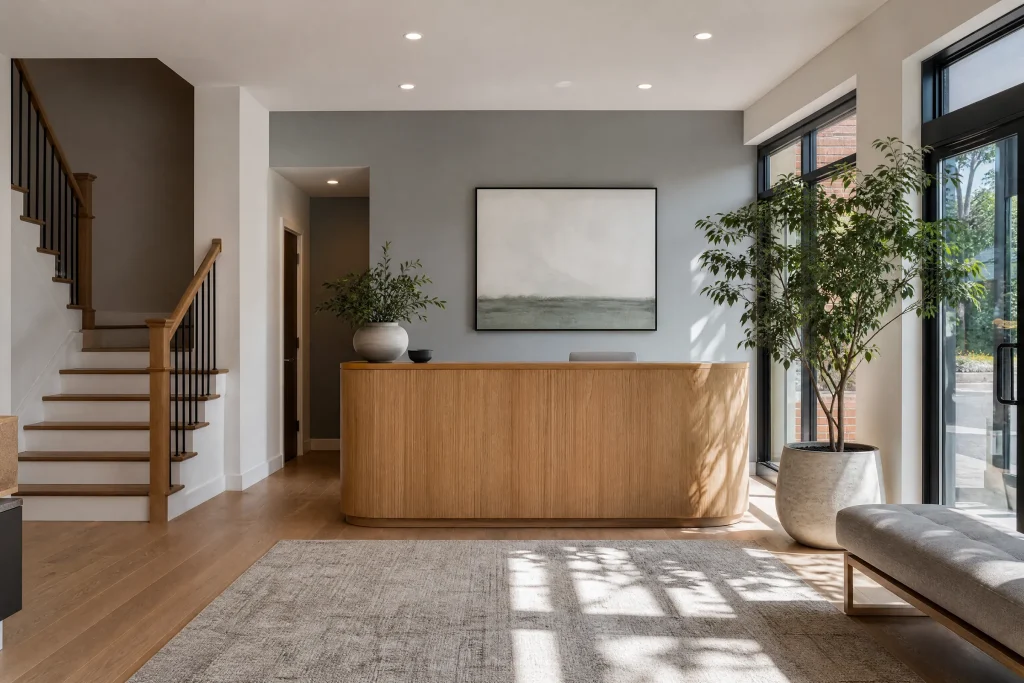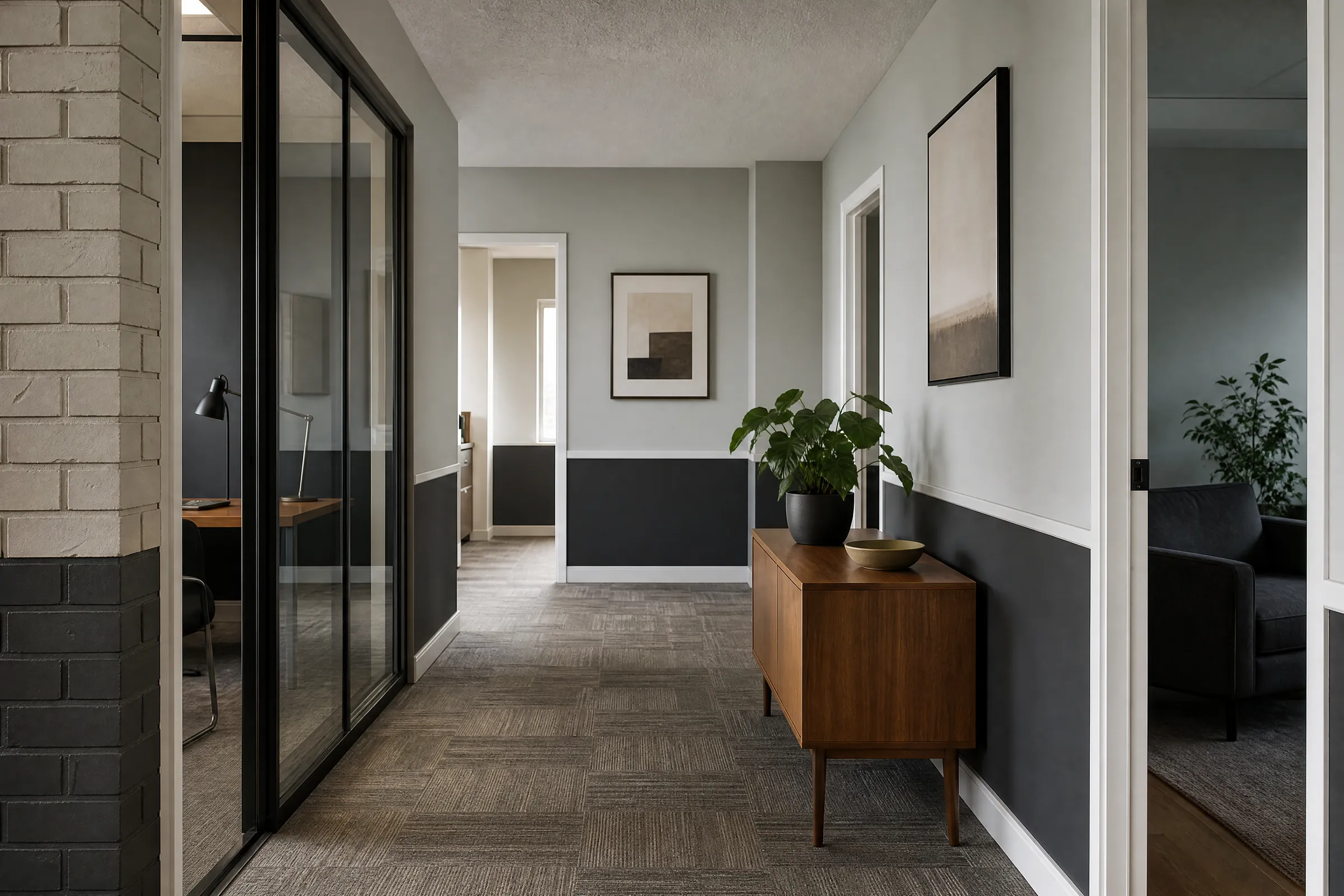

An older brick office building in downtown Whitby
Downtown Whitby, around the corner where Brock Street meets Dundas Street, mixes heritage homes with a strip of older commercial buildings. This job was in one of those: a brick building with shops at street level and professional offices on the floors above. At some point it was renovated, and an elevator was added at the back with a small lobby off the side entrance. The front entrance still leads into the original stair hall, a tall space with plaster walls, a wood handrail and big windows on the landing.
The building owner asked us to repaint the two shared spaces tenants and visitors use every day: the original stair hall, from the street door up to the top landing, and the newer elevator lobby. The shops and offices themselves were not part of this round.
What we were dealing with
The stair hall was the heart of the job, and nearly all of the effort went into preparation, much of it done up close from a scaffold. The plaster had the full range of problems that older buildings collect:
- Long cracks running diagonally up from the corners of the landing window and the street door, the kind that open and close a little with the seasons.
- A patch on the upper wall where the plaster had pulled away from the lath behind it and sounded hollow when tapped.
- Many layers of old paint on the walls and trim, including a glossy oil finish on the baseboards and handrail that new waterborne paint would not grip without help.
- Old repairs that had been filled with the wrong material and stood proud of the wall, visible as bumps in the light from the landing window.
The upper walls rise well above ladder height over the stairs, which is why we worked from a rolling scaffold tower on the landing and a stair platform on the flight below. The elevator lobby was simpler, mostly scuffed drywall, but its brass-finished elevator doors and call plates needed careful masking.
Protection and preparation, step by step
Before any sanding: protecting tenants and keeping dust down
- Sanding was done by hand with damp sponges or with sanders hooked to a filtered vacuum, so dust from the old layers was caught where it was made instead of drifting up the stair hall.
- The stair treads were covered with fitted runners of floor protection taped at the edges, so the stairs stayed safe to walk on for tenants coming and going.
- Plastic sheeting was hung across the doorways from the stair hall into the ground-floor shop and the upstairs office corridor, to keep dust out of the businesses.
- The heavy sanding and the scaffold work were done in the evenings and on weekends, when the offices were closed and the shops had shut for the day.
Repairing the plaster
- Using a hooked blade, we cut along every crack to make a small groove for the filler to key into, and vacuumed out the loose grit.
- For the hollow patch, we drove screws fitted with plaster washers through it into the lath; the washers draw loose plaster back tight with no need to cut it out.
- Cracks and the reattached area were bridged with fibreglass mesh tape and filled with setting compound, a powder mixed on site that cures by reaction and shrinks less than ready-mixed filler. Two or three thin layers were applied and feathered wide.
- The old bumpy repairs were cut back flush and refilled.
- Once the repairs had hardened, the walls were sanded and the whole wall was checked with a work light held flat to the surface.
Trim and handrail
- The glossy oil-finished baseboards, door casings, balusters and handrail were cleaned with a degreaser to remove decades of hand oils.
- Next came a scuff-sanding to knock down the shine, and a coat of adhesion primer formulated to sit on old oil paint.
- Where the baseboard had drifted off the plaster, the gap was closed with acrylic caulk that takes paint.
Priming the walls
Plaster repairs and bare plaster were spot-primed with a primer suited to plaster, and then the entire wall surface was primed once more, edge to edge. On an old wall with many patches, a full prime coat is the surest way to keep the repairs from showing up as dull or rough areas in the finish.
The elevator lobby
The lobby floor was covered, the brass doors and frames were wrapped in low-tack protective film, scuffs were washed off and the dents filled, sanded and spot-primed.
Applying the finish coats
Stair hall walls and ceiling
The ceiling over the stair was rolled in two coats of flat white, which hides the small undulations old plaster ceilings always have. The walls were brushed at every edge and rolled with two coats of an acrylic eggshell in a warm off-white. On the tall upper wall we worked from the scaffold in full-height sections so each stretch was finished wet-to-wet, with no lap lines.
Trim, doors and handrail
Baseboards, casings, the doors off the stair hall, the balusters, the newel and the handrail all got two coats of a waterborne alkyd enamel in semi-gloss, in a deep charcoal, brushed and laid off along the grain. The dark colour hides hand marks far better than white, and it picks out the line of the stair and every door frame against the pale walls.
Elevator lobby
Lobby walls took two coats of taupe, a warm one, in a scrubbable eggshell, cut by hand along the brass frames. The ceiling, which was in good condition, got one coat of flat white to freshen it.
Between coats everywhere, we waited for the manufacturer’s stated recoat window. The stair hall stays cool in the evenings, so the second coat often went on during the next shift rather than the same night.
Choosing colours for an older building
The owner wanted the stair hall to feel bright but still suit the building’s age, rather than looking like a new office tower. During the free colour consultation we brushed out sample pots of several off-whites and soft creams directly onto the primed plaster beside the landing window. We looked at them with morning sun pouring through that window and then after dark with only the hall fixtures on; the brighter whites looked cold and showed every remaining texture in the plaster. The warm off-white held up in both lights and sits well against the charcoal woodwork. In the lobby, the existing taupe was kept, sampled against alternatives, because it works with the brass doors and ties the newer space back to the warm tones of the old hall.
Leaving shared spaces usable
Tenants and customers had to use the stair hall every working day, so each shift ended with the scaffold locked and moved hard against the landing wall, the stair runners checked and re-taped, dust vacuumed with a filtered vacuum, and the plastic at the shop and office doors left sealed. Paint, tools and debris were cleared out of the hall at the end of every shift so nothing sat in the way of an exit.
What to watch from here
- Fine cracks can still reappear at the window and door corners in an old building that moves with the seasons. A hairline in the first winter is not a failure of the repair; mark it and touch it up with the labelled can of wall colour we left.
- Hand marks on the charcoal rail come off with a soft rag dampened in soapy water.
- Keep the touch-up cans indoors, away from freezing, and note which is the wall eggshell, the trim semi-gloss and the lobby taupe.
- If a hollow sound returns anywhere on the upper wall, have it checked before it cracks through.
Why careful prep matters in downtown Whitby
Older commercial buildings near Brock and Dundas have the same plaster, old oil trim and many coats of paint as the heritage houses around them, so the prep has to match the building rather than a modern office. Doing that work in the evenings and on weekends keeps shops open and offices quiet. Our commercial painting service handles storefronts, offices and shared building spaces like these, and we have been painting in Toronto and the GTA since 2010, with plenty of work across Durham Region. There is more about older homes and buildings on our Whitby painting page.
If you own or manage a building downtown, contact us to book a visit and you will receive a written, itemized quote.