
A condo kitchen along the Yonge corridor
North York Centre is the stretch of Yonge Street lined with condo towers, and painting work in those buildings looks more like a downtown job than a house job. This suite was a two-bedroom unit on an upper floor, with an open kitchen along one wall and a small island with stools that doubles as a breakfast counter. The cabinets were original to the building: flat slab doors and drawer fronts in a light wood-grain veneer, likely maple or birch over a particleboard core, with white melamine boxes and shelves inside.
The owner liked the clean slab style but found the honey-coloured wood dated and too warm against the white walls and grey floor. They wanted a lighter, cooler kitchen without the noise, dust and building approvals that a full replacement would involve.
What made this job different
Thin veneer
Wood veneer on condo slab doors is very thin, often less than the thickness of a business card. It takes paint well once primed, but aggressive sanding can cut straight through it to the core beneath, which then shows as a dull patch. All sanding here had to be light and by hand.
Lifting edges
Next to the dishwasher and under the spot where the owner kept the kettle, the veneer on several doors had started to lift along the bottom edge. Steam from both had softened the glue. Paint would not fix that; the veneer had to be glued back first.
Building rules
Condominium buildings usually require trades to book the service elevator, work within set weekday hours and protect the hallway, and many restrict spray equipment inside suites. So every door would be finished with rollers and brushes, and we had to get a smooth, even finish without spraying.
Small space, shared air
A condo shares its ventilation with neighbours, and the owner would be living in the unit during the work, so the products needed to be as low in odour as possible.
Preparation, from the elevator to the doors
- Building logistics. The service elevator was booked ahead, and we carried materials up during the booked window. Runners went down along the corridor from the elevator to the suite door, with corner guards on the door frame.
- Protection in the suite. The kitchen floor and the path to the second bedroom were covered. Counters, the range and the fridge were covered with masking film, and we taped film over the kitchen exhaust so dust stayed out of the duct.
- Finishing room. With brush and roller as the plan, the spare bedroom became the finishing room. Its floor was covered, the furniture was moved to one side and draped, and we set up folding drying racks so doors could lie flat while they dried.
- Removal. Each door and drawer front was numbered, and the hinges and pulls were bagged with the same numbers.
- Veneer repair. Lifting veneer was cleaned out underneath, wood glue was worked in with a thin blade, and the edge was pressed down with a veneer roller and held with small clamps until the glue set. Squeeze-out was wiped off right away so it would not leave a hard ridge under the primer.
- Cleaning. All doors and frames were washed with a mild degreaser, which in a condo kitchen is mostly about hand oils around the pulls, then rinsed and dried.
- Sanding. The factory clear coat was scuffed by hand with fine sanding sponges and a soft block, just enough to remove the sheen. Corners and edges, where veneer is most easily cut through, were given only a light pass.
- Priming. A waterborne bonding primer was rolled on in a thin coat and brushed out at the edges. The exposed particleboard edges of the boxes, where the veneer stops, were primed too so the paint would not soak in. After drying, the primer was sanded very lightly and wiped down.
Getting a smooth finish without a sprayer
For the finish coats we chose a zero‑VOC self-levelling cabinet enamel. It flows out after it goes on, so roller texture and brush marks soften as it dries, which is the main reason a rolled cabinet door can look close to sprayed.
Flat slab doors suit this method well. On each door we rolled a thin, even coat with a fine foam mini roller, working in one direction from edge to edge, then tipped off the whole surface lightly with a soft synthetic brush to break any small bubbles. Edges were done first with the brush, so the flat face could be rolled last without lap marks. Backs got two coats, then the doors were turned and the fronts got two, with the manufacturer’s recoat time respected between every coat. Doors stayed flat on the racks in the finishing room so the enamel could level without sagging.
The face frames, the island panels and the toe kicks were painted in place with a small microfibre roller and a brush. Two finish coats went on everywhere, and nothing was painted inside the white melamine boxes.
Pale blue below, white above
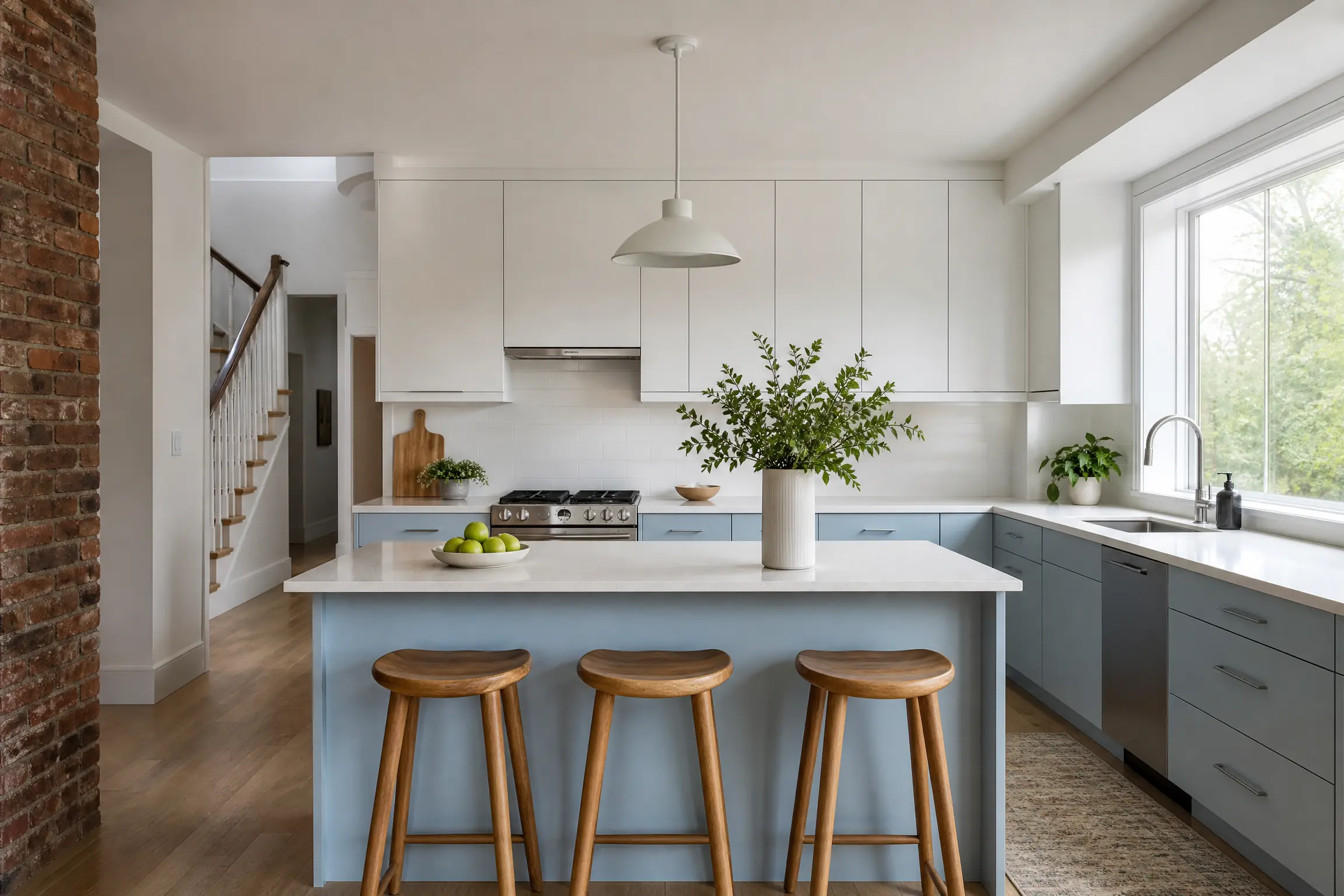
The owner wanted to keep the kitchen bright but did not want it all white. At the colour consultation, we painted a pale blue, a pale sage and a couple of clean whites from our sample pots onto primed boards and held them against the counter and the grey floor. The condo faces west, so we looked at the samples late in the morning, when the light in the room is indirect and cool, and again at the end of the day, when the sun comes in low and warm. The pale sage turned yellow in the evening sun. The pale blue stayed clear and soft in both lights, and the owner chose it for the lowers and the island, with a clean white on the uppers so the top of the wall would blend into the white ceiling and walls.
Both colours were finished in satin. Now the kitchen reads as a light, airy wall, with pale blue slabs below the counter, white slabs above, and slim stainless pulls that went back in their original holes.
A tidy suite and a tidy hallway
Each day, we kept to the usual condo working hours, and before leaving we vacuumed the kitchen and finishing room, bagged waste to carry down in the service elevator, and wiped down and lifted the corridor runners so the hallway was clear for neighbours overnight. The owner had a working kitchen each evening, with the counter cleared and the sink usable.
Care tips for painted veneer doors
- Keep the kettle away from the cabinet doors, or put a small board under it, so steam does not rise straight onto the door edges again.
- Open the dishwasher only after the cycle has cooled a bit, or step back from it, so the steam does not hit the doors beside it.
- Clean the doors with a lightly damp microfibre and, if needed, a drop of gentle soap. The enamel takes some weeks to fully harden.
- We left labelled jars of both colours, each lid showing the sheen and which cabinets it was used on.
- If a veneer edge ever lifts again, have it glued before the paint around it cracks.
Why this approach works in North York condos
Condo towers along Yonge Street and around North York Centre often have the same factory veneer or melamine kitchens, and building rules can make spraying inside a suite impossible. A careful rolled finish with a self-levelling enamel, combined with proper veneer repair and a bonding primer, gives these kitchens a new look within the rules. You can read about our kitchen cabinet painting service, see our work in North York, or learn about our painters across Toronto. To start, reach out with your building’s trade rules and we will plan an itemized written quote around them.