
The house: an Erin Mills two-storey with its first coat still on the walls
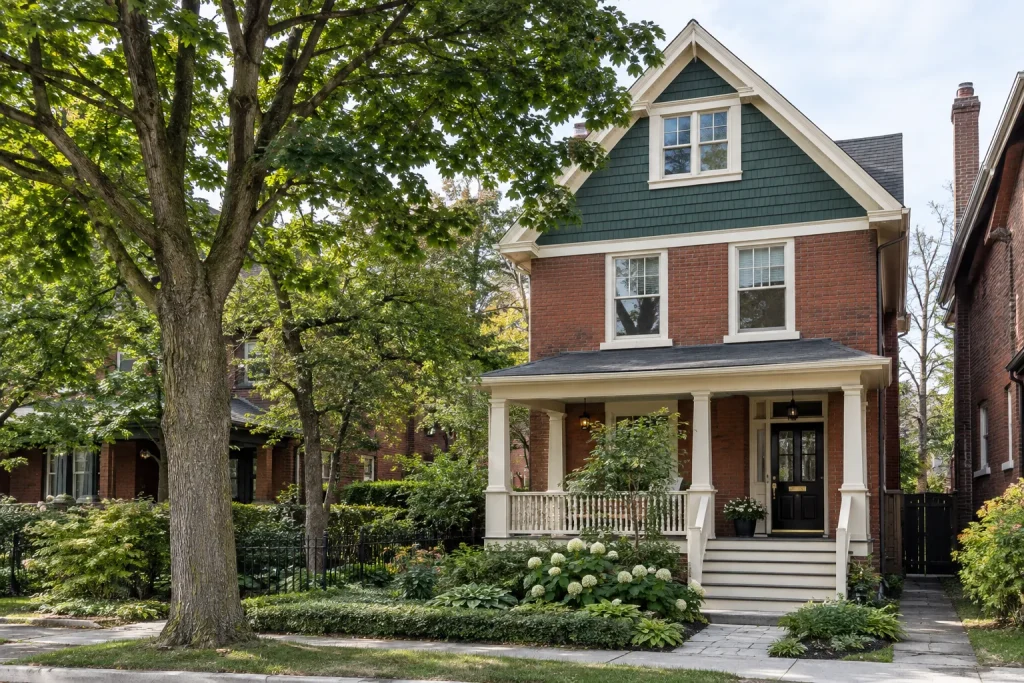
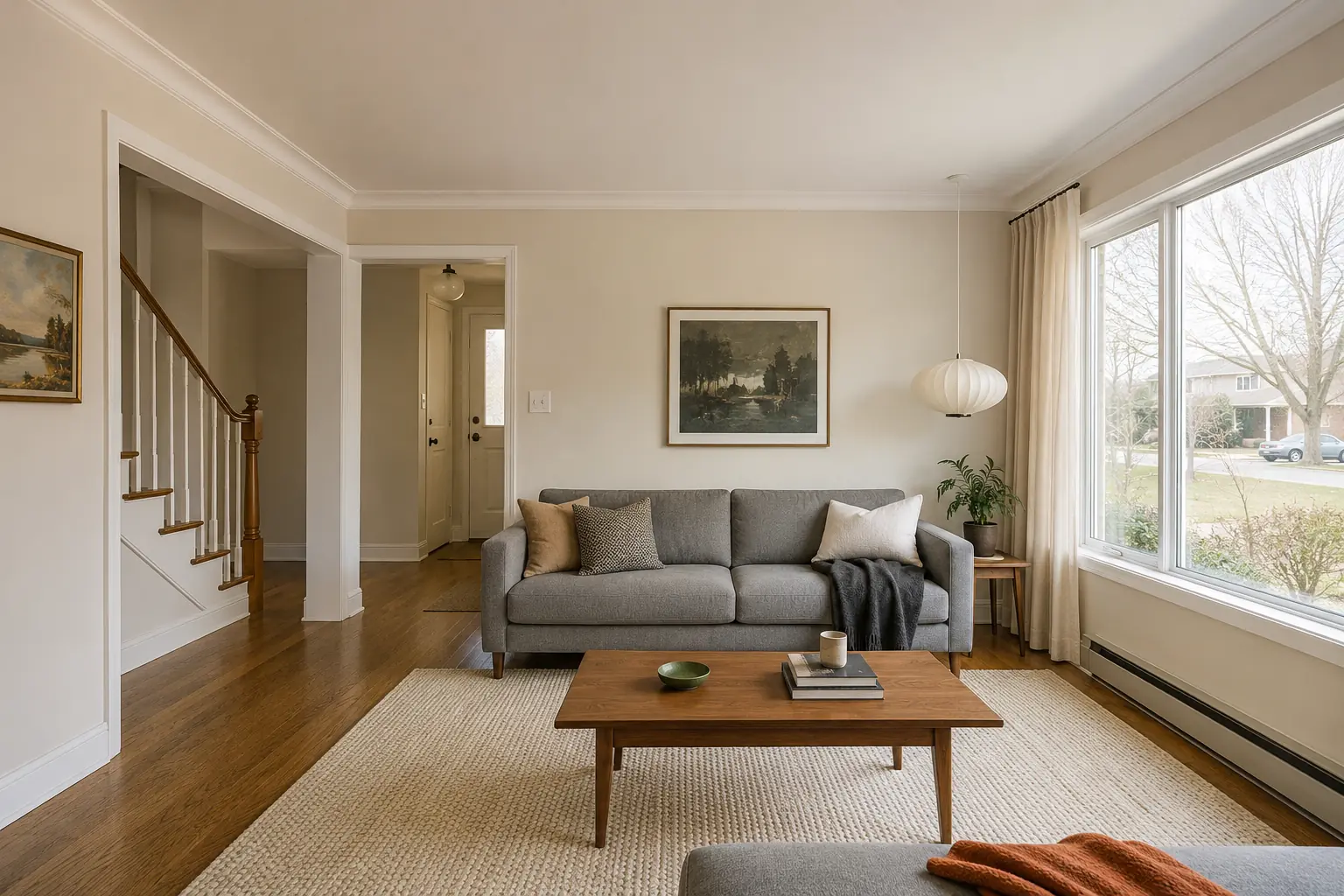
This detached home in Erin Mills belongs to the large wave of subdivision building that filled much of Mississauga between the 1970s and the 1990s. Outside it is brick with vinyl above; inside it is drywall, builder trim and a centre-hall plan whose foyer rises the full two storeys to a window over the front door. The living and dining rooms run together across the back of the main floor, with oak floors and a wide bank of windows facing the yard, so most of the daylight in the house comes through that one room.
Almost every wall still carried the flat, pale beige the builder had sprayed before the first owners moved in. Over the decades it had been patched with whatever can was in the garage. The owners asked us to repaint the entire interior: walls and ceilings on both floors, the foyer and stairwell, every baseboard and casing, and the interior doors. Kitchen cabinets and the oak stair itself stayed out of scope.
What made this more than a colour change
Flat builder paint marks easily and cleans badly. Every chair-back rub in the dining room and every shoulder scuff along the upstairs hall had either stayed put or been scrubbed into a shiny patch. Touch-ups from mismatched cans showed as blotches whenever low sun came across the walls from those big back windows. Along the upper hall, a row of nail pops had pushed through near the ceiling line, which is typical where framing has dried and settled over the years, and the metal corner bead at the stair landing had been dented by furniture moves.
The real challenge was height. The foyer wall climbs past the upstairs landing, while the stairwell wall beside it drops below the landing to the main floor. No single ladder could reach all of it safely, so the staging had to be planned first, and that decided the order for the whole house.
How we protected the house and prepared the surfaces
Furniture, floors and fixtures
- In each room, furniture was pulled to the middle and covered. The green sofa, dining table and chairs went under clean drop cloths over plastic so nothing could shift or pick up dust.
- The oak floors and the stair treads were covered with breathable floor protection, taped to itself and never to the finish.
- Switch plates, outlet covers, vent grilles and door hardware came off, went into bags and were labelled by room so each piece went back where it started.
Washing
Flat paint holds skin oil and cooking film, and fresh paint over a greasy wall can lose its grip. We washed the walls near the kitchen, around every switch, along the hallways and up the stair with a mild degreasing cleaner, then rinsed with clean water and let them dry fully before any filler went on.
Drywall repairs
Each nail pop was fixed rather than just filled: a drywall screw went in a little way from the old nail to draw the sheet back against the framing, the nail head was set below the surface, and both spots were filled and sanded. The dented corner bead at the landing was built back to a straight line with setting-type compound, which hardens firmly on an outside corner, then sanded. Anchor holes and small dents took lightweight filler.
Caulking
Where baseboards had pulled away from the wall or old caulk had cracked at the casings, we cut out the loose material and ran fresh paintable acrylic caulk, tooled smooth so the joint would read as a clean line under semi-gloss.
Primer
All repairs were spot-primed with a drywall primer-sealer so the patches would not flash, meaning show as dull spots, through the eggshell. The shiny scrubbed areas and blotchy touch-ups got the same primer. The rest of the original paint was sound and pale, so a full prime coat on every wall was not needed.
The painting, surface by surface
Foyer and stairwell from staging
We began at the highest point. Adjustable staging went up in the foyer right beside the foot of the stair, levelled on padded feet so it could not mark the floor, which let the high foyer ceiling and walls be cut in by brush and rolled from a stable platform. With the top finished, the staging came down a level and we worked toward the main floor, so nothing above was disturbed once it was done.
Ceilings
Every ceiling took two coats of flat acrylic ceiling paint, rolled in one direction toward the main window so any texture lines would follow the light instead of crossing it. Flat ceiling paint hides small dips and seams well, and it reflects light without glare.
Walls
Walls were cut in at ceilings, trim and corners with an angled sash brush, then rolled with a medium-nap roller in sections small enough to keep a wet edge. Two finish coats of eggshell went on everywhere, and the second waited until the can’s stated recoat window had gone by. In a busy hall a wet edge matters: rolling into paint that has started to set leaves lap marks that show in raking light.
Trim and doors
The builder trim had a thin, slightly yellowed semi-gloss. It was cleaned, scuff-sanded so new enamel would bond, and given two coats of water-based semi-gloss enamel by brush. The six-panel doors came off their hinges and were painted flat on horses in the garage: panels and their moulded edges by brush first, the flat rails and stiles laid off in long strokes, then both faces and all four edges. Painting doors flat keeps sags out of the panel profiles.
Picking a white that suits oak floors and strong daylight
The owners knew they wanted something light and calm, and we brought sample pots of a few whites to the colour consultation. Each was brushed onto a generous patch of the living room wall and again beside the front window in the foyer, then looked at in the morning and again in the evening. The cool white went faintly blue in the shaded foyer. The creamiest one looked yellow beside the oak floors. The one chosen was a soft warm white with only a touch of grey, which stayed neutral in both rooms and sits quietly behind the green sofa. Trim and doors went one step cleaner in semi-gloss so the casings frame each doorway, and ceilings stayed flat white.
Sheen was as much a decision as colour. Eggshell has a low sheen that wipes clean without the shine of satin, which suited a family house that had suffered under flat paint. An upstairs bedroom took a muted sage on its walls, also in eggshell, chosen from the same sample session.
Order and housekeeping while the family lived at home
The owners stayed in the house the whole time, so the work moved in an agreed order: foyer and stairwell, then the main floor, then the bedrooms one or two at a time. Paths through the house stayed clear, the kitchen was never blocked, and at the close of each workday we vacuumed sanding dust, stacked materials in one corner of the garage, folded drop cloths and put the rooms back in a usable state. Low-odour paint helped with windows closed in cooler weather.
The finished house now reads as one space. The foyer is a clean warm white from the floor to the high window, the stair wall has no dents or patches showing, and the living room walls look even from every angle the daylight hits them.
Looking after the new finish
- Fresh paint is dry to the touch quickly but takes a few weeks to cure fully. Until then, avoid scrubbing; a soft damp cloth is enough.
- Once cured, the eggshell walls can be wiped with mild soap and water. Avoid abrasive pads, which can polish a spot.
- We left a labelled can of each colour and sheen, marked by room, for small touch-ups. Feather touch-ups out lightly with a small roller rather than dabbing with a brush.
- A nail pop or two can still appear as the house moves with the seasons. These are easy to screw, fill and touch up.
- Watch the caulk where baseboards meet the floor in the front entry. Winter boots and salt are hard on it.
Why this approach fits homes across Mississauga
Erin Mills, Meadowvale and Cooksville hold thousands of houses from the same building era, and many still carry their original flat paint. A whole-house repaint there is usually less about hiding damage than about changing to a sheen that can be cleaned, fixing the nail pops and dented corners that come with age, and planning safe access for an open foyer. Our house painting service is set up around exactly that: protect, wash, repair, prime what needs it, then at least two finish coats on every surface.
We have painted homes across Toronto and the GTA since 2010, and more of our local work is on the Mississauga painting page, along with jobs elsewhere in Peel Region. If your own two-storey has a high foyer and tired builder paint, ask for an itemized written quote and a free colour consultation with real sample pots.