
A working warehouse bay in Concord
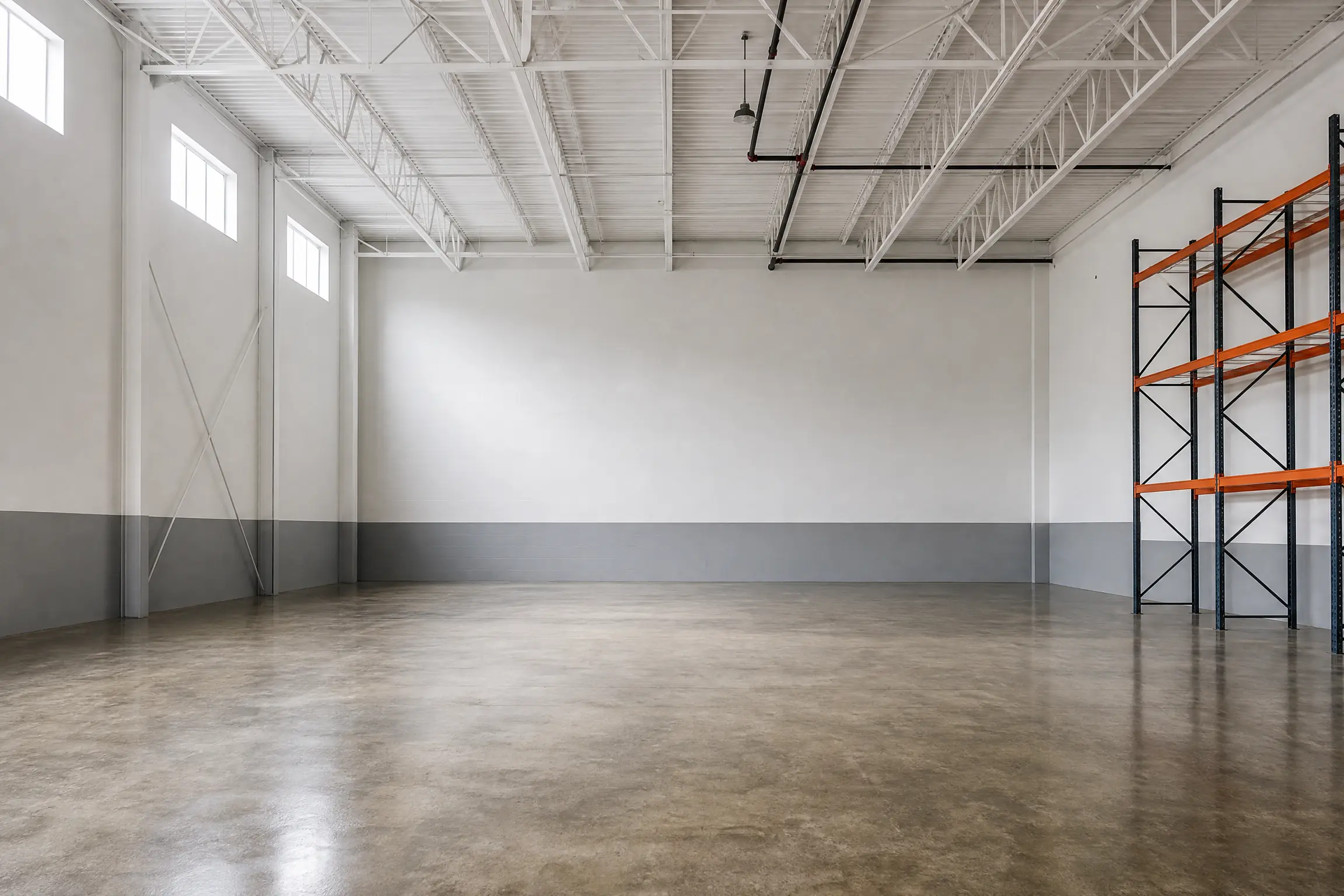
The building is a single-tenant industrial unit in Concord, the part of Vaughan where warehouses, showrooms and offices sit side by side. Behind a small office at the front is a high warehouse bay: concrete block walls, steel racking down one side, overhead dock doors, a forklift charging station and an open roof of steel joists and corrugated deck, with the ductwork, sprinkler mains and conduit all left exposed.
The owner wanted the bay brighter and cleaner before a round of customer visits. The roof steel had never been painted, the block walls were grey with grime and marked by forklifts, and the steel around the dock doors was rusting. The business could not close during the week, so every phase was planned for weekends, starting once the last shift had gone home on Friday.
What the bay looked like before
The open ceiling
Bare galvanized deck, joists and ducts soak up light rather than bounce it back, so the bay felt darker than its fixtures should allow. The steel was dusty but sound, with no peeling mill coating and only light surface rust on a few joist ends near the dock doors, where cold, wet air rolls in every time a door opens in winter.
Walls, frames and bollards
The block walls had been painted once, long ago. Near the docks they carried a film of exhaust and hydraulic oil, and there was dust on every ledge. Forklift scrapes ran along the lower walls at the racking ends, and a few blocks had chipped corners. The steel frames around the dock doors had surface rust where slush blows in, and the yellow on the bollards beside the doors was mostly worn away.
The hard part
Painting a ceiling above live stock is what needs the most planning. Overspray from ordinary paint drifts and sticks wherever it lands, on racking, boxes and the forklift, and this bay could not be emptied. Everything had to fit into a weekend and leave the floor clean and usable on Monday morning.
Protecting the bay and preparing the surfaces
- Before each weekend, the owner’s staff moved pallets a short way from the walls, and we wrapped the racking ends, the stock on the lower shelves, the forklift chargers and the dock levellers in plastic sheeting.
- Light fixtures, skylight frames, smoke detectors and electrical panels were masked. The red sprinkler mains were taped and wrapped so they would keep their colour, and any covering on the sprinkler system came off at the end of every shift.
- Hard hats, safety footwear and high-visibility vests were worn throughout, following the site’s own rules, and the lift work zone was coned off.
- The deck, joists and duct runs were blown down with compressed air a section ahead of the sprayer, so loose dust would not end up trapped in the coating.
- Block walls were vacuumed and then scrubbed with a degreasing cleaner near the docks. Indoors, a pressure washer would have flooded the floor drains, so this was done by brush and rinsed with sponges.
- Forklift gouges and chipped block corners were filled with a masonry patching compound, sanded flush and sealed with a dab of alkali-resistant masonry primer.
- Rust on the dock door frames, the joist ends near the doors and the bollards was taken back with wire brushes and sanding discs, then every bare spot was given a rust-inhibiting metal primer.
Painting the bay, surface by surface
Roof deck, joists and ductwork
The joists, roof deck and ductwork were sprayed from a rented scissor lift with a waterborne dry-fall coating in flat white. Dry-fall is made for this: overspray dries in the air and settles as dust that sweeps up, rather than sticking to racking or stock below. It still went on in two coats for even hiding over the bare steel, and the lift moved bay by bay so the plastic below only had to cover one section at a time. Conduit and duct runs were sprayed along with the deck, so the whole ceiling reads as one white surface, while the red sprinkler mains stayed masked.
Block walls
The block walls were rolled with a thick-nap roller, which pushes paint into the pores of the block, in two coats of a durable acrylic in an eggshell finish. While the lift was busy overhead, a second painter worked the end walls on an extension pole, cutting in by brush along the dock door frames and the base of each wall. Coat two waited for the recoat time on the label, which in an unheated bay on a cool weekend meant checking the wall by touch rather than trusting the clock.
Dock frames and bollards
The dock door frames got two coats of an industrial alkyd enamel in a dark grey over the metal primer. The bollards and the pallet-jack stops were brought back to safety yellow in the same enamel, again in two coats, so they stand out from the forklift seat.
Colour decisions for a working building
For the ceiling, white was the obvious choice: a white roof throws the light from the fixtures back down onto the floor and the racking, which makes the bay brighter without changing a single fixture. The walls took more thought. At the free colour consultation, a warm white, a bright white and a light grey went onto the block beside the dock doors from sample pots, and the owner looked at them under the bay’s own lights, then again with a door rolled up to daylight. The grey hid scuffs but made the bay feel smaller, and the bright white turned bluish under the fixtures. The owner chose the warm white and kept yellow for the bollards and stops alone, so they read clearly against it.
The bay now has a white ceiling from wall to wall, clean white block walls, dark grey frames around the dock doors and bright yellow bollards standing guard beside them.
Leaving it clean for Monday
Because staff walked back into the building on Monday morning, each weekend ended with the plastic taken down, the dry-fall dust swept and vacuumed from the floor, ladders and the lift returned to their staging spot, and empty cans and used sheeting removed from site. Waterborne, low-odour coatings meant the front office could be used first thing Monday without paint smell drifting through. Even on long weekend shifts, the site was tidied before we left at night.
What the owner should know about upkeep
- Forklift scrapes on the block walls can be touched up from the labelled cans we left, which are marked by surface and sheen.
- The racking ends and the walls beside the dock doors will take the most hits. Corner guards at forklift height protect the paint where it matters most.
- Sand, prime and touch up any rust spot on the dock frames as soon as it shows, before slush works in under the enamel.
- The dry-fall ceiling needs nothing beyond occasional dusting with a blower.
- When the bollards lose their yellow, a light sand and one coat of the same enamel brings them back.
Why weekend work suits Concord’s business units
Concord’s warehouses and showrooms rarely stop during the week, so most commercial painting there has to happen on evenings and weekends, with racking, stock and forklifts protected rather than moved out. Freeze-thaw winters also bring slush and salt in through every dock door, which is why the rust work on the frames and joist ends carried as much weight as the finish coats. We have painted across Toronto and the GTA since 2010, for businesses throughout York Region, and our painting services in Vaughan include showrooms, offices and warehouse units as well as homes.
If your unit needs work that has to fit around operating hours, get in touch for an itemized written quote.