
A lake home bought with a problem on its walls
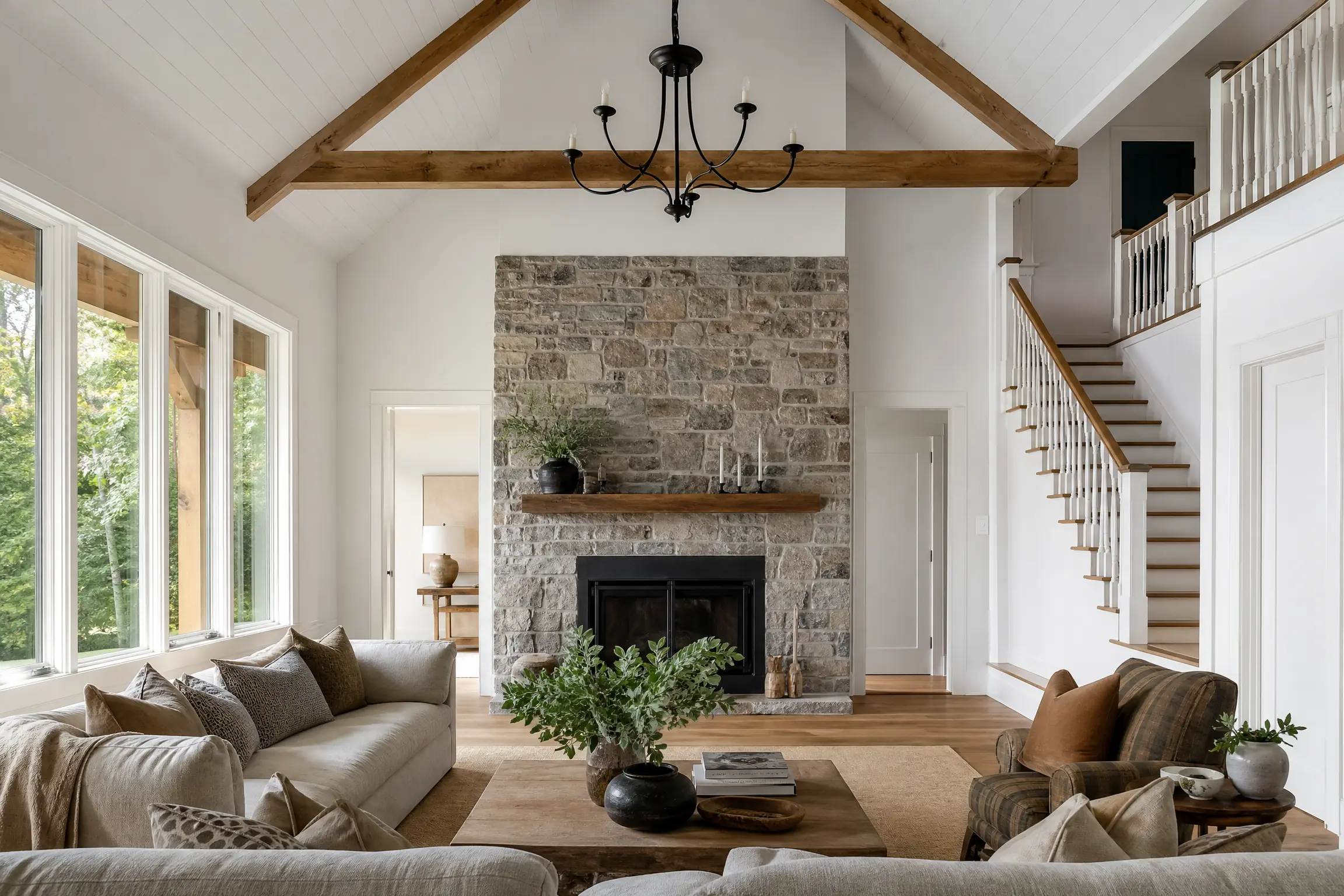
Caesarea is the community on the shore of Lake Scugog, and many of its homes are built to look out over the water. This one has a great room that rises the full height of the house, with glass looking out to the water, a stacked-stone fireplace, light oak floors, and a loft landing upstairs that overlooks the room. The new owners bought it from people who had lived there a long time and smoked indoors. When the furniture left, the walls told the story.
The owners asked us to paint the great room, the loft landing and stair wall, and the front hall, with all the trim and interior doors in those spaces, before they moved in. They wanted the house to look and smell clean and the room to be a bright white. For the loft railing, they asked for the yellowed white spindles and the stained handrail to be painted black, so the railing would read as one dark line against the new white.
What smoke does to paint
From across the room, the walls looked an old cream colour. Up close, the signs were plain:
- a yellow-brown film over every wall and ceiling, darkest near the top of the great room, where smoke had risen and collected;
- pale rectangles where pictures had hung, showing the original paint colour beneath the film;
- a slightly tacky feel to the walls, and brown streaks running down below the loft landing;
- white spindles on the loft railing gone the same dull cream as the walls, under a handrail with a sticky film on it;
- switch and outlet covers stained a tobacco brown;
- the smell of smoke in the empty house.
A damp white rag wiped across the wall came away brown. That simple test showed how much residue was on the surfaces.
Why a coat of paint would not have worked
Nicotine and tar residue is sticky, so new paint does not bond well to it. Worse, the stain dissolves in water, so the water in latex paint draws it up through the new coat. Paint straight over a smoke-stained wall and the yellow blotches come back, often in streaks where the residue was thickest. The residue also holds much of the smell. The fix is to remove as much residue as possible, then seal what is left under a primer that blocks both stain and odour.
Washing, sealing and protecting
Protection
With the house empty, protection was mostly about floors and fixtures. Paper and canvas went down over the oak, with plastic laid on top in the washing areas since the cleaning was wet. The stone fireplace was sheeted in plastic hung from above, and the windows were masked. All switch and outlet covers were removed; the owners chose to replace them, so new covers went on at the end.
Washing
- Ceilings were washed first, using a heavy-duty degreasing cleaner, working from the scaffold tower and on extension poles. Washing from the top means anything that drips lands on a surface not yet cleaned.
- Walls were washed from the bottom up. Drips running down onto a dirty wall leave clean streaks that are hard to blend; washing upward avoids that.
- We used two buckets, one with cleaner and one with rinse water, and changed the water often. Brown water spread back onto a wall just moves the residue around.
- Every surface was rinsed twice with clean water to remove the cleaner, which can interfere with adhesion if left behind.
- Once dry, each wall and ceiling was checked with a damp white rag. Areas that still coloured the rag, mostly the upper great room walls and the ceiling under the loft, were washed and rinsed again.
Trim and doors
Baseboards, casings and doors were washed the same way, then scuffed with a sanding sponge so the primer would grip. Small gaps were caulked after washing, never before, so the caulk was not laid over residue. The loft railing was washed spindle by spindle, and the clear coat on its handrail was sanded dull so the primer could bond to it.
Sealing
Every washed surface, ceilings, walls, trim, doors and the loft railing, was primed with a pigmented shellac-based primer made to block stains and odours. Shellac primer has a strong smell until it dries, so the windows were opened, box fans set to blow out of the house, and the painters wore organic-vapour respirators. This is one reason the job was done while the house was empty. After the first coat dried, we looked over every surface. A few areas near the top of the great room and under the loft still showed a faint yellow, so those got a second coat of the shellac primer.
Repairs
Nail holes and small dents were filled after the first primer coat, sanded and spot-primed again, so the filler sat on a sealed surface rather than one carrying residue.
The paint, by surface
Ceilings
The great room ceiling and the ceilings in the hall and loft were each rolled twice in flat white. The great room ceiling was done from a scaffold tower set on locked casters over plywood, with extension poles for the reach.
Walls
Every wall had its edges brushed along the ceiling, stone, windows and trim, then was rolled, twice over, in eggshell. On the tall walls, the scaffold allowed the painter to roll from the top down to the floor in one continuous lane while a second painter kept the edges wet. The second coat waited for the recoat time stated on the can.
Trim and doors
Baseboards, casings and both faces of each door were finished by brush with a pair of semi-gloss waterborne enamel coats. Semi-gloss is easy to wipe, which suits trim in a lake house where people come in from the water.
Loft railing
Over the shellac primer, the spindles and handrail took two brushed coats of a satin black waterborne enamel, with the landing floor masked beneath them. Each spindle was painted top to bottom in one pass, so no lap marks show where window light falls across the railing.
A white chosen in an empty room
Choosing colour in an empty house is harder than it sounds, because there is nothing in the room to judge against. Our free colour consultation used sample pots of a few whites, brushed onto primed boards, then placed the boards where the owners’ sofa and rug would go, next to the stone, and in the hall. Those boards were checked early in the day and again near sunset. One white had a yellow base that, after the history of these walls, the owners did not want. A cool white looked grey in the hall, which gets little daylight. They chose a clean white with a hint of grey that looked fresh in both spaces.
Eggshell was picked for the walls so they can be wiped easily once the family is living there. Zero‑VOC finish paint was used throughout, so the odour of new paint would be gone quickly.
The great room is now white from the oak floor to the peak, with no trace of yellow on the ceiling or under the loft, the black loft railing draws a crisp line along the top of the room, and the stone fireplace stands against an even, clean background.
Tidy at the end of each day
Wet washing means dirty water, rags and sponges. Each evening we emptied buckets outside away from the lake side of the property, bagged used rags, rolled the scaffold clear of the windows, and stored tools and primer cans in the garage. When the job was finished, the drop sheets, plastic and masking were removed and the floors were vacuumed and damp-mopped.
Advice for the owners
- Odour. The primer seals the walls and ceilings. Carpets, window coverings and the heating ducts can also hold smoke odour; cleaning the ducts and changing the furnace filter before moving in is worthwhile.
- If yellow appears. A spot that shows through later should be cleaned and dabbed with shellac primer before touching up. Do not just add more wall paint.
- Cleaning. Eggshell can be wiped with a damp cloth and mild soap.
- Touch-up paint. The wall, ceiling, trim and railing colours were left in labelled cans in the garage, with the leftover shellac primer.
Why this approach suits homes around Lake Scugog
Scugog has three kinds of home: heritage houses and storefronts in Port Perry, farmhouses around Blackstock and Greenbank, and waterfront homes and cottages along the lake at places like Caesarea. Interior repaints here suit the colder months, when outdoor work stops, and that is also when many owners get a newly bought house ready. A house bought with smoke-stained walls needs washing, sealing and painting in that order, ideally before the furniture arrives. Our Scugog painting page covers the exterior side of lakefront work as well.
All Painting has painted GTA homes since 2010, including many across Durham Region. Our interior painting service deals with the cause of a stain before covering it, and always applies at least two finish coats, with each surface listed in a written quote. If you have bought a house with smoke-stained walls, contact us for a free quote.