
An office building in King West and its parking levels
King West is mostly glass condo towers now, with warehouse lofts, offices and storefronts mixed in. This project was a mid-rise office building in that part of downtown, with tenants on every floor, a ground-floor elevator lobby finished in warm taupe around brass elevator doors, and underground parking shared by tenants and paying visitors that stays open around the clock.
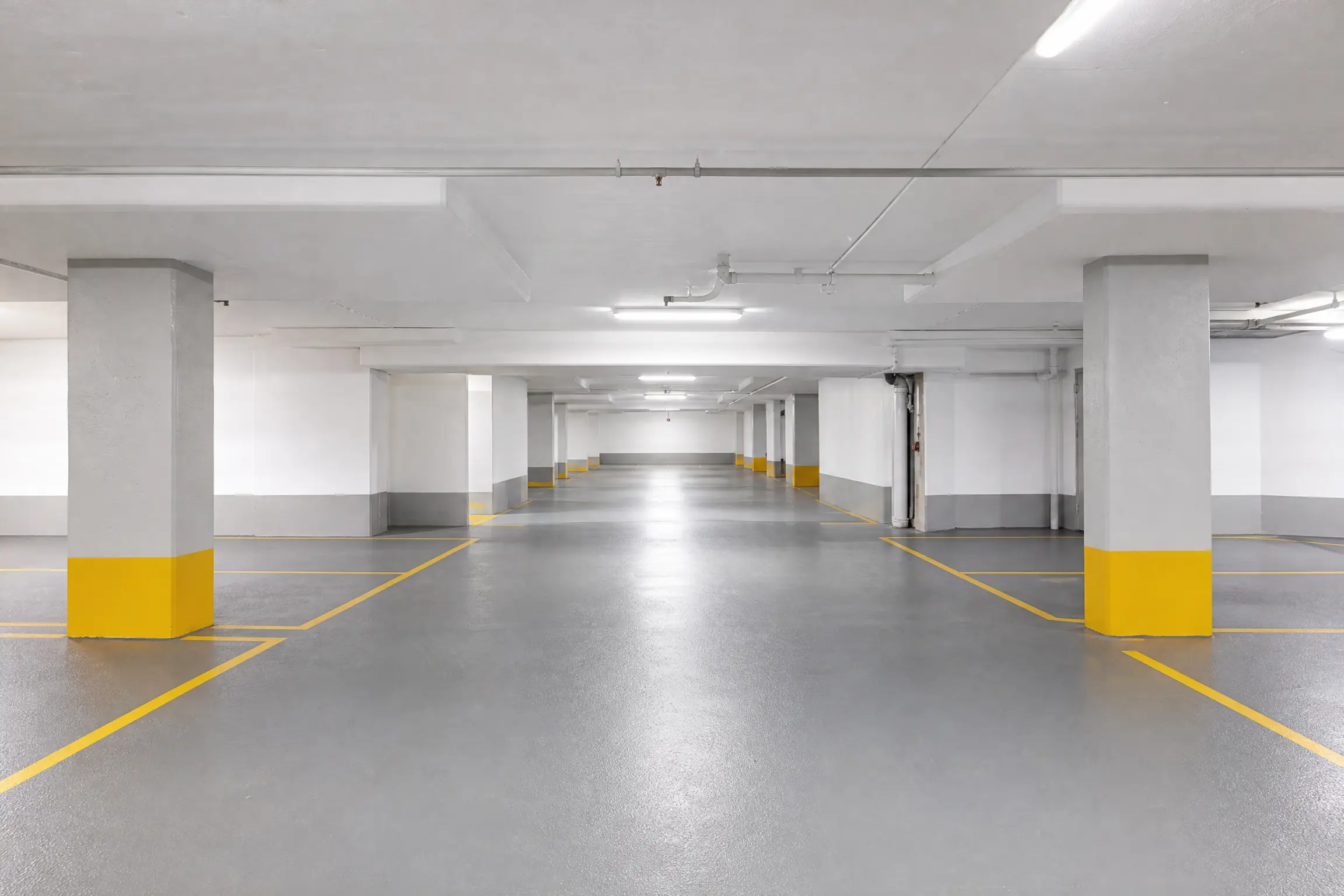
The owner wanted the parking levels made brighter and easier to find your way around, and the lobby refreshed at the same time. The parking walls and columns had last been painted long ago in a uniform grey that had gone dark with exhaust film, and visitors regularly got lost looking for their car.
What we found below ground
- A dark film of exhaust soot over the upper walls, heaviest around the ramps between levels where cars accelerate.
- Rubber marks and paint transfer from bumpers on the lower walls and around the base of almost every column.
- Salt staining that rose well up the walls near the entry ramp, where slush drips off cars all winter.
- Hairline shrinkage cracks in the poured walls, which were cosmetic but would show through new paint.
- A ceiling crowded with sprinkler mains, drain lines, conduit and exhaust ducts, none of which could be painted or splashed.
The main challenge was not the concrete, though. It was that the garage could never fully close. Every phase had to leave tenants and visitors a working route in and out, and the overspray from spraying large walls had to stay well away from parked cars.
Planning a garage that never closes
With the owner, we split each level into sections along its drive aisles. Each section was closed overnight, when few cars use the garage, with notices posted well ahead so regular parkers knew which stalls to leave empty. Cones, barrier tape and signs marked the closed section, and the drive aisle beside it stayed open with a clear walking path to the stairs and elevators.
Street parking in the core is close to impossible for a work van, so this came up at the quote stage. Our vehicle used the loading dock, and materials stayed in a locked storage cage below ground, so nothing had to be carried across a sidewalk every night.
Preparation, one section at a time
- Before washing, the sprinkler heads in the section were bagged, and the conduit, drain lines and electrical panels were covered with plastic and tape.
- Walls and columns were pressure-washed with a degreasing detergent to cut the exhaust film, working from the top down so dirty water ran to the garage’s trench drains. Unlike most indoor spaces, a garage is built to take water.
- Salt stains near the ramp got a second wash with a masonry cleaner and a stiff brush, then a thorough rinse.
- Fans ran to dry the concrete; we did not prime until it was dry to the touch and a taped plastic patch stayed dry overnight.
- Hairline cracks were filled with a flexible masonry crack filler so slight movement would not split the new coating, and gouged column bases were rebuilt with a cement-based patch.
- Bare and patched areas got a penetrating masonry primer, and so did the whole of any wall where the old grey had worn thin.
- Before spraying, we hung plastic sheeting from the ceiling down to the floor along the edge of the section, a curtain that kept overspray off the cars parked in the open aisle beside it.
The coatings and how they went on
Colour by level
Rather than one colour throughout, each parking level got its own, chosen from bright yellow, a medium blue and a green. The level colour covers the walls and columns from the floor up to the ceiling line, so as soon as a driver comes down the ramp, the colour tells them where they are, and a visitor only has to remember a colour to find their car.
Walls and columns
The large wall areas were sprayed with an airless sprayer and back-rolled straight away, which pushes the coating into the texture of the concrete and evens out the finish. Columns were rolled and brushed, as spraying around a column wastes material and drifts. Each surface received a double coat of waterborne acrylic formulated for concrete in parking structures. Waterborne products matter underground: the exhaust fans keep air moving, but a solvent coating would still have carried its smell up the elevator shafts to the lobby. Coat two waited out the drying period printed on the product sheet; in a cool garage, that usually pushed it to the following night.
Stair and elevator vestibules
The small vestibules at each level, where people wait for the elevator, were rolled in a washable eggshell in a light warm grey, with the steel door frames finished in semi-gloss enamel. Keeping the vestibules neutral lets the level colour stand out on the garage side of the door.
The ground-floor lobby
Up in the lobby, the work was done overnight after the building closed. The stone floor was covered with protection board, the brass elevator doors and frames were wrapped in protective film, scuffs and dents were filled and spot-primed, and the walls took a pair of rolled coats of scrubbable eggshell in the existing warm taupe, freshly matched from a chip of the old paint. Brushwork along the brass frames was done freehand for a sharp line.
How the level colours were chosen
There is no daylight underground, so the usual habit of checking colours in morning and evening light gave way to checking them under the garage’s own fixtures. Through our free colour consultation, we painted large sample patches on a column on each level, side by side, and the owner walked through to compare them. Pale versions looked washed out under the fluorescent lights; the stronger yellow, blue and green read clearly from the far end of a drive aisle. In the lobby, the goal was the opposite: no change at all, so we tinted the new paint to match the existing taupe and checked it against the brass before rolling.
Leaving each section ready for morning traffic
Every overnight shift ended the same way: plastic curtains down and bagged, sprinkler head bags removed and checked off on a list, cones and tape cleared, the section swept, and the stalls reopened before the first tenants arrived. Wet surfaces were signed until dry. In the lobby, the floor protection was lifted and the space vacuumed before the doors opened. Materials went back into the storage cage each night, so no ladders or cans were ever left in a drive aisle.
Keeping the garage and lobby looking right
- Labelled touch-up cans of every level colour, the vestibule grey and the lobby taupe were left in the storage cage.
- The bottoms of the columns will take the most hits. Touching up the bottom of a scraped column with a small roller keeps the level colour solid.
- A spring wash of the lower walls near the entry ramp clears winter salt before it builds up on the coating.
- If any hairline crack reopens and shows through, it can be filled with the same flexible filler and touched up.
- Water dripping through the ceiling slab is worth reporting early. Leaks bring efflorescence and peeling with them.
Why this approach suits downtown buildings
In the core, buildings almost never stop: garages stay open, lobbies serve tenants early and late, and street parking for trades is scarce. Planning access, loading and overnight phasing at the quote stage is as much part of commercial painting downtown as the coatings themselves. The same thinking applies to offices, restaurants and storefronts along King Street and in Liberty Village, and you can read more on our Toronto painting page. Since 2010 we have worked as painters across Toronto and in the surrounding GTA, and Zero‑VOC and low-odour paint options are available wherever people are close by.
If you manage a building in the core, get in touch and you will receive an itemized quote in writing for each area.