
An older house a few streets back from the lake
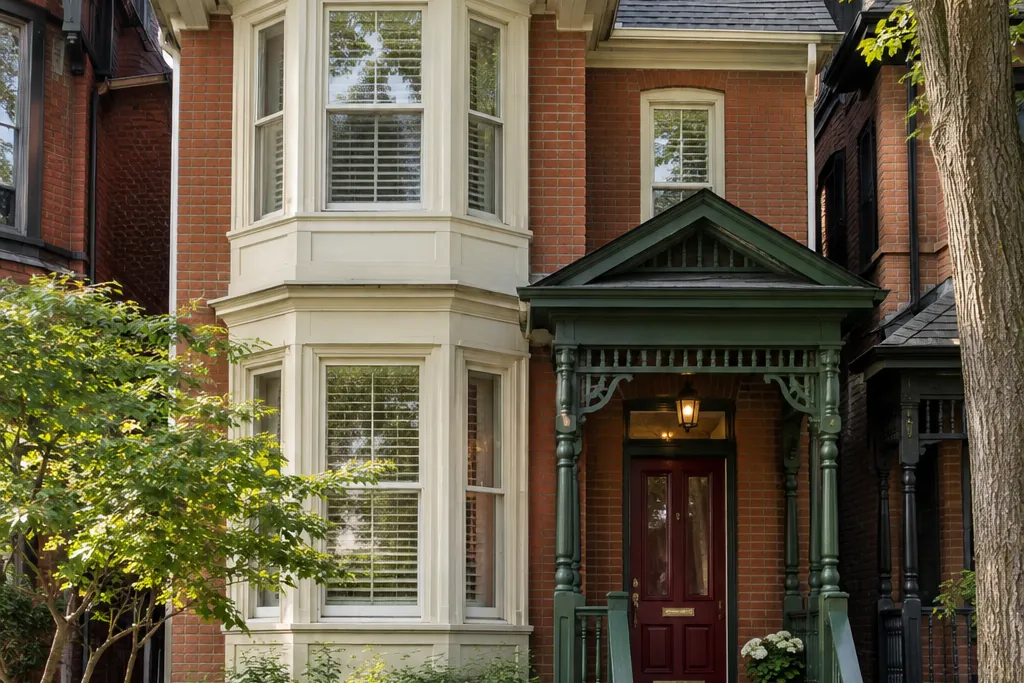
This house sits on a quiet street in Bronte, close enough to Lake Ontario that the wind carries the smell of the water on most afternoons. It is a storey-and-a-half with wood clapboard on the main floor, narrower clapboard on the upper storey under the roof line, a small gabled porch over the front door and a lawn running to the sidewalk. Older homes like it are part of what gives Bronte and the streets near downtown Oakville their character, and most of them carry a long paint history on their exterior wood.
The owners had bought the house painted a pale butter yellow, which had faded and was peeling in long strips. They wanted a clear change: a dark blue-green on the main floor, white on the upper storey and trim.
What we found under the yellow
A scraped section of clapboard on the west wall showed the layers like rings in a tree: the yellow on top, then a light grey, then a cream, then a dark green near the wood. The lower coats were brittle and oil-based, and the newer latex on top was peeling because it had lost its grip on the hard, glossy layer beneath.
Why the old paint came off wet
With paint this old and this brittle, how it comes off matters as much as what goes on. Dry scraping and open sanding turn hard old coats into fine dust and flakes that drift across the yard, the porch and the neighbours’ gardens, and power washing adds water forced into the clapboard laps. None of them were used. Each wall was misted, scraped by hand and sanded only with dust collection, and every chip was caught on sheeting.
Other conditions
- The lake-facing west wall had the worst peeling and several boards with open checks along the grain.
- The upper storey siding was sound but chalky.
- Caulk around the windows and at the corner boards had dried and cracked.
- Going from pale yellow to a dark colour meant the base had to be uniform, since dark paint shows every patch and edge beneath it.
Containment, removal and repair
Lake wind decided which days were used for scraping. On gusty afternoons even damp chips can lift off the sheeting, so the removal work was kept to calm mornings, and painting was saved for dry, mild stretches between late spring and early fall, when the wood was dry and the temperature suited the paint. The sequence on each wall ran as follows.
- Ground containment. Heavy poly sheeting was laid along each wall before work started on it, extending well out from the foundation and taped to the siding above grade so nothing could slip underneath. Garden beds were covered, and the walkway and stoop were sheeted. Neighbours on both sides were told when scraping was planned so windows facing the work could be closed.
- Wet scraping. Loose paint was misted with water from pump sprayers, then scraped by hand. Damp chips fall straight down onto the poly instead of turning into dust.
- Feathering the edges. The edges of the remaining sound paint were sanded smooth with shrouded sanders connected to a HEPA-filtered vacuum, so dust was captured at the sanding pad.
- Daily clean-up of debris. At the end of every day, chips were gathered from the poly, the sheeting was HEPA-vacuumed and folded inward, and the debris was bagged and sealed.
- Wood repairs. Open checks in the west wall clapboard were filled with exterior wood filler, and nail heads that had worked out were set and filled.
- Caulking. Old caulk at the window casings and corner boards was removed and replaced with fresh paintable sealant. We left the clapboard’s horizontal laps open so they can drain.
- Washing the upper storey. The sound but chalky upper siding was hand-washed with a mild cleaner and sponges rather than pressure-washed, and rinsed gently.
- Priming. All bare wood, filled areas and the scraped transitions were primed. For the lower walls we used an exterior acrylic primer tinted grey, which gives a dark finish colour a more even base and helps it cover in two coats.
Applying the new colours
Dark blue-green on the main floor
Dark colours absorb far more heat from the sun than pale ones, and on a sunny wall that heat can make wood move and cheaper paint soften. For the clapboard we used a 100% acrylic exterior paint formulated to hold deep colours, in satin. It was brushed on board by board, with the underside of each lap coated first, so every edge was sealed. Two finish coats went on, and the second waited for the manufacturer’s recoat time. We avoided painting any wall while it was in full sun, following the shade around the house through the day.
White above and on the trim
The upper storey siding received two coats of white exterior acrylic in satin. Window casings, corner boards, fascia and soffits took two coats of white semi-gloss, applied by brush, which gives the trim a slightly harder face and a crisp line against the dark body.
Why dark blue-green and white
The owners started with a navy in mind. Our free colour consultation began with sample pots of a navy, a charcoal and a couple of blue-greens, each brushed onto primed boards that were held up against the house beside the white trim sample. In morning light off the lake, the navy looked flat and almost purple; in the evening, the charcoal disappeared into the shadows of the street trees. The deeper blue-green kept its colour in both, and it suits the lawn and the mature trees in front. A clean white, rather than an off-white, was chosen so the upper storey and trim stand out clearly.
From the sidewalk, the house now has a deep blue-green base with sharp white trim around each window, and a bright upper storey under the roof line.
Keeping old paint chips off the property
Cleanliness on this job was about more than looking tidy. Besides the daily bagging of chips, the stoop and walkway were wiped down each evening so the family was not tracking dust indoors, and tools were vacuumed before they were stored. When the painting was finished, the poly was HEPA-vacuumed one last time, folded inward and bagged, and the window sills, stoop and walkway were wiped with damp cloths.
Caring for the finish
- If the paint is ever damaged and old layers show, do not dry-sand or power-wash them; the brittle lower coats shatter into dust and chips, so mist and hand-scrape the spot instead, or call us.
- A rinse with a garden hose and a soft brush once a year keeps lake grime off the white trim.
- The dark blue-green will fade a little on the west wall first. Touch it up early with the labelled can left in the basement, which also has the sheen and the surfaces noted on the lid.
- Keep an eye on the caulk at the lake-facing windows and reseal small gaps as they appear.
Why this approach fits older Oakville homes
Many older houses in Bronte and around the harbour have the same layered paint history, and the wind and sun off Lake Ontario make the exterior coats work hard. Taking the old paint off wet and by hand, catching every chip, and building a sound base before a colour change are part of how we handle exterior painting on homes like these, and on older houses throughout Halton Region. We have been painting houses in Toronto and the surrounding GTA since 2010, and no wall we paint gets fewer than two finish coats.
If your older home has peeling paint and you are not sure what is underneath, ask us for a visit; we will look closely at the old coatings and set out the prep and painting in an itemized written quote.