
A floating stair in a newer North Oakville home
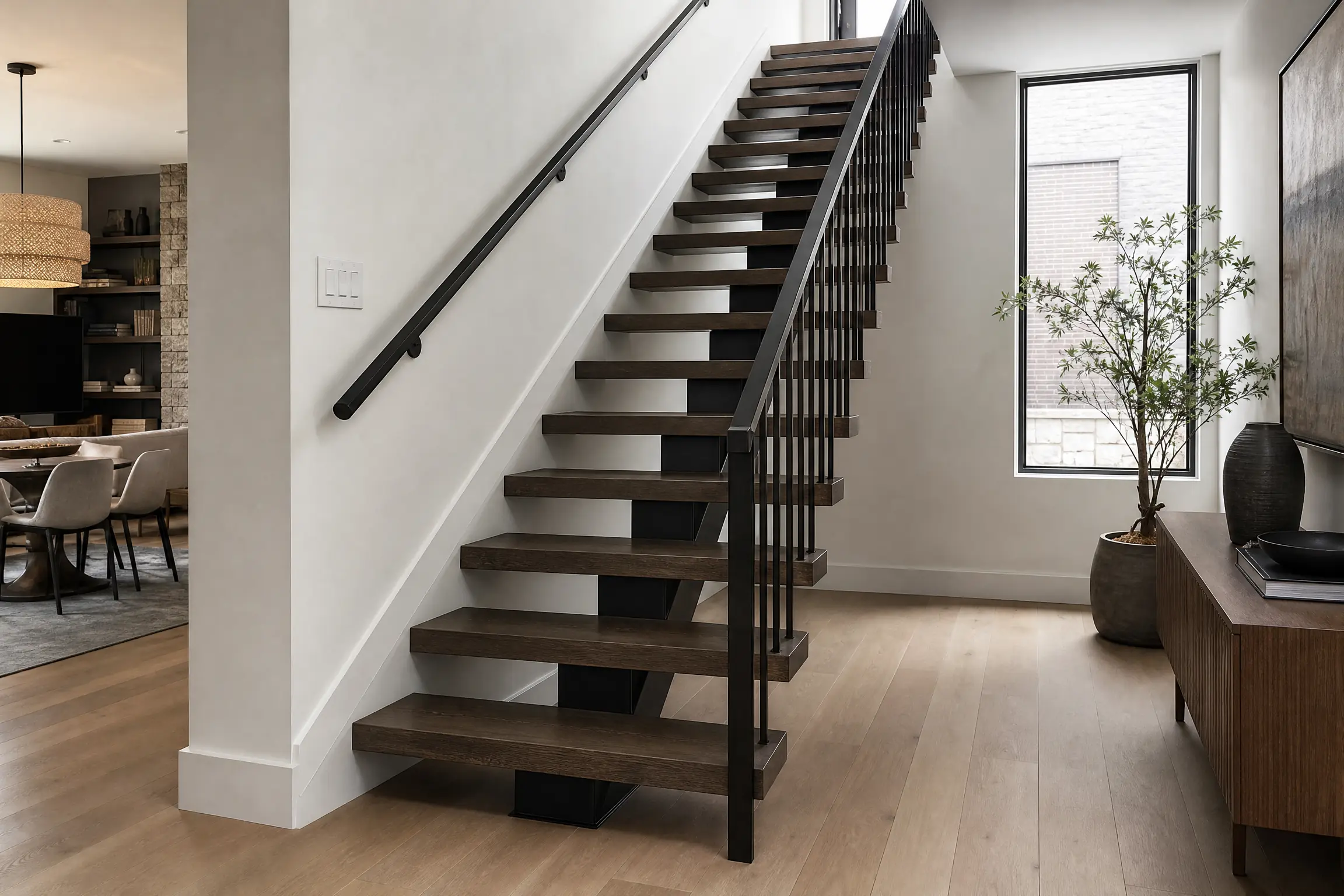
North Oakville is the newest part of the town, with streets of recently built homes north of the older Glen Abbey and River Oaks subdivisions. This one is a modern detached house with a tall front entry: a window runs most of the way up the stairwell, and an open-riser staircase climbs beside it between two black steel stringers. The treads are solid white oak, each one bolted across the stringers with no riser behind it, so you can see through the stair to the window. A glass railing with black metal posts and a black top cap runs along the open side.
When the owners moved in, the treads had a pale, almost white factory finish. In the bright entry it looked washed out, and it was already showing grey traffic marks on the bottom steps. They wanted the treads much darker, a charcoal brown to tie in with the black steel, and they wanted the metal parts and the stairwell walls cleaned up at the same time.
Why open risers changed the job
On a closed stair, only the top and front edge of a tread are seen. On an open-riser stair, the underside of every tread is visible from the hall below and from the entry looking up, and so are the back edges. Every face had to be sanded and coloured, including the undersides, which meant working upside down beneath each tread without dripping onto the one below.
The steel was in rougher shape than it looked from a distance. Moving furniture up the stairs had chipped the black paint on the stringers and on some of the railing posts, and there were small spots of surface rust at the chips. The stairwell walls still wore a builder flat finish that marked with every bump of a laundry basket, and there were nail pops along the drywall seams near the window. The glass panels had to come through all of it without a scratch.
Prep: glass, steel, oak and drywall
Protecting the glass and floors
Every glass panel was covered on both sides with a clear surface protection film, and the edges were taped where the glass meets the posts. The hardwood at the bottom of the stair and on the upper landing was covered with breathable protection board. We set up a rolling scaffold tower in the entry, casters locked, so the full height of the stairwell wall could be reached without leaning ladders against the window frame.
The white oak treads
- The factory coating was sanded off the top of each tread with a random orbital sander hooked to a dust extractor, working up to 150-grit for an even, tight surface on white oak.
- Front edges, back edges and undersides were sanded with a detail sander and by hand, so all visible faces would take colour the same way.
- The sharp factory corners on each tread were eased slightly by hand, which helps a finish hold at an edge that bare feet and socks catch.
- Dust was vacuumed from the treads and the stringers, and each tread was wiped with a lint-free cloth.
Black steel stringers and posts
- The stringers and posts were washed with a degreaser to remove hand marks and furniture-polish residue.
- Chipped spots and rust were sanded back to clean, bright metal, and the surrounding paint was scuffed with a fine pad.
- Bare steel took a rust-inhibiting primer, applied with a small brush only where the metal was exposed.
Stairwell walls
Nail pops were reset with drywall screws, then the screw heads and dents were filled with lightweight spackle, sanded with a pole sander and spot-primed so the patches would not flash through the new finish.
Colouring the oak and refinishing the steel
For the treads, the owners and we chose a hardwax oil instead of a stain and varnish. A hardwax oil soaks into the wood and hardens in it, leaving a matte surface that suits a modern stair, and worn spots can later be cleaned and re-oiled locally without sanding the whole tread. The first coat was a charcoal-tinted oil, applied thin with a pad, worked into the grain and buffed off so no excess sat on the surface. Once it had cured enough to recoat, according to the label, two coats of the clear matte hardwax oil followed. We did the undersides first, then the edges, then the tops, so any drips fell onto surfaces not yet coated.
The steel stringers and posts took two coats of satin black direct-to-metal acrylic enamel. On the long stringers we used small foam rollers, laid off with a brush, which gave a smooth coat without spray mist near the glass. The narrow posts and the top cap were brushed. Between coats, we waited for the full recoat time on the can, which matters with metal enamels that can lift if recoated too soon.
On the walls, two coats of a scrubbable matte white were cut in by brush at the window frame and ceiling and rolled from the scaffold in full-height passes, so no lap lines show in the window light.
Finding the right dark
We brought offcuts of the same white oak to the free colour consultation and coloured them with a few tints, among them a true black, a charcoal brown and a dark walnut. Placed on the bottom tread, the black looked flat and hid the grain, while the walnut looked warm against the cool steel. The charcoal brown sat well with the black metal and still showed the oak’s grain when the morning sun came through the window. For the walls, a plain white with no warm undertone kept the glass and steel looking crisp; matte was chosen to hide small wall flaws, in a scrubbable formula so marks could be wiped off.
Keeping a modern entry clean while working
A house with glass railings and an open stair shows every fingerprint and speck of dust, so cleanliness during the job mattered. The extractor ran on every sander, and the tower was wiped down before being moved. The family used a side entrance from the garage, and the stair was closed for the time the oil needed to cure. At the end of every day, floors were vacuumed, the protection film on the glass was checked and oily pads were laid flat to dry outside before disposal. Zero‑VOC paint was used on the walls, and the hardwax oil we chose has a low odour.
Caring for oiled treads and black steel
- Clean the treads with a damp mop and a soap made for oiled floors; general cleaners can strip the oil.
- When the front of a tread looks dry or pale, clean it and wipe on a little of the clear oil we left behind; a full recoat is rarely needed.
- Avoid carrying furniture against the stringers; chips in metal enamel can rust if left bare.
- A labelled jar of the black enamel and a can of the white wall paint are stored in the utility room for touch-ups.
Why this suits newer Oakville homes
Many new builds in North Oakville have open stairs, tall windows and builder flat paint, and they come with finishes chosen for speed rather than wear. Refinishing open-riser treads takes more care than closed ones, since every face shows, and working beside glass and steel means protecting surfaces that cannot be sanded or repainted. You can read about the range of homes we paint in Oakville, from heritage houses near the harbour to new builds, and about our work elsewhere in Halton Region.
Since 2010 we have painted and stained stairs across Toronto and the GTA, from older oak stairs to floating ones like this. Our staircase staining service page covers more of the options. For an itemized written quote on your own stair, contact All Painting and we will come out to measure.