
The suite and the building it sits in
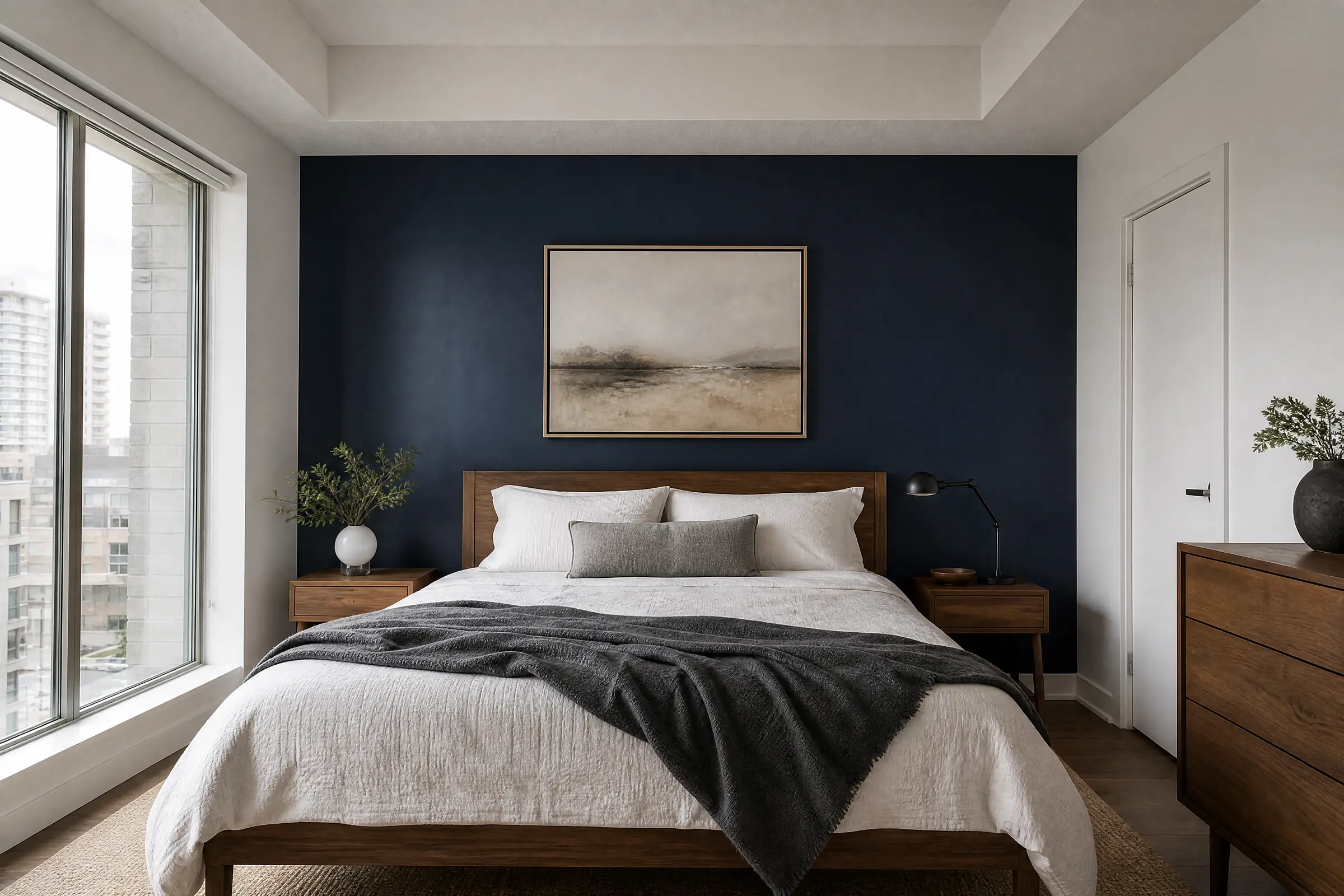
This was a two-bedroom unit on a high floor of one of the glass towers that have gone up around the Vaughan Metropolitan Centre. Like most new suites, it had smooth drywall walls, drywall bulkheads boxing in the ductwork over the kitchen, and a single coat of flat builder white on everything, including the ceilings and closets. The owners had moved in, lived with it for a while, and then decided on colour: a deep navy wall behind the living room seating, a crisp white for the open dining area under the pendant lights, and a pale warm grey for the bedrooms and hall.
We painted every wall and ceiling in the suite, the trim and interior doors, and the inside of the primary bedroom closet. Window frames, the balcony door and the kitchen cabinets were masked and left alone.
Marks from moving day and the limits of flat paint
Builder flat paint is soft and thin. It marks if you brush past it with a jacket, and when you try to wipe a scuff away it smears and leaves a polished patch. In this suite the damage was concentrated where furniture had come in: deep gouges at the corners of the hall, a long scrape along the bedroom wall where a bed frame had been turned, and dents on the outside corner by the front closet. Several earlier dabs of touch-up paint had dried shinier than the surrounding wall.
What made it more than a simple repaint
- Building rules. Towers like this typically set working hours, require a booked service elevator for every load in and out, and ask that the corridor carpet be protected from the elevator to the suite door, so we planned for each.
- Deep colour on one wall. Navy over white is one of the harder changes to cover evenly, and an uneven navy wall shows every lap in daylight.
- Nowhere to wash out. Brushes and rollers could not be rinsed in the suite’s kitchen sink, so cleanup had to be planned before work started.
- Small rooms, full furniture. The owners were living in the suite, so there was little floor space to move furniture into.
Getting in, covering up and preparing the walls
Corridor, elevator and entry
Each arrival and departure used a booked service elevator, as the building requires. Corrugated board went down from the elevator to the suite door, and the entry floor inside was covered with self-adhesive protection film that peels off cleanly. Everything that came in, from ladders to paint, came in on a single trip whenever possible.
Floors, kitchen and furniture
Inside, the laminate floors were covered with drop cloths over film along every wall. The kitchen counters, island and appliances were wrapped in masking plastic. With space tight, we worked one zone at a time: furniture in the living area was pulled to the dining side and covered while the navy wall was done, then moved back so the dining walls could be painted.
Repairs
- Shallow dents and nail holes were filled with lightweight spackling.
- The deeper gouges at the hall corners were filled first with a setting-type compound, which hardens chemically and does not shrink, then skimmed with a lighter finish layer.
- All patches were sanded smooth with a fine sanding sponge, and the dust was vacuumed rather than swept so it would not settle in the wet paint later.
- Gaps where baseboards met the walls were caulked with a paintable acrylic caulk.
Priming
Every filled spot got its own dab of primer to keep it from showing through the colour. The navy wall was primed in full with an acrylic primer tinted mid-grey. Starting from grey rather than white lets a deep colour build up faster and look even, and it is the step that keeps a navy wall from looking streaky in daylight.
How each surface was painted
Ceilings and bulkheads
The ceilings and kitchen bulkheads were rolled in a flat ceiling white, two coats, with the bulkhead edges cut in by brush so the corners stayed sharp under the pot lights.
The navy accent wall
For the accent wall we used a scuff-resistant matte. A deep colour in a flat finish can burnish when it is rubbed, so the matte we chose was a harder formula made for marks. The edges along the ceiling and adjoining white walls were cut in by hand twice, and the wall was rolled top to bottom in even lanes, keeping a wet edge. Two finish coats over the tinted primer gave a solid, even navy. We checked it under a work light held flat to the wall before calling it done.
Dining area, bedrooms and hall
The open dining area was painted white in a washable eggshell, and the bedrooms and hall got the pale warm grey in the same sheen. Eggshell has just enough sheen to wipe clean without showing every bump in the drywall. Every room had two finish coats, the second rolled only after the label’s recoat interval.
Trim and doors
The baseboards, casings and interior doors were lightly sanded and wiped down, then given two brushed coats of waterborne semi-gloss enamel. Doors were painted in place, with hinges masked, so nothing had to be stored in the hall.
Picking a navy that held up in a glass tower
Suites in these towers get a lot of light from floor-to-ceiling glass, and the light changes fast. At the free colour consultation, we opened sample pots of several navies and brushed broad swatches onto the actual accent wall, along with white samples on the dining side. In bright midday light the softest navy looked almost slate, while under the evening pendants the darkest one went close to black. The owners chose the middle option, which stays recognizably blue at both ends of the day. For the dining area they picked a clean white without yellow in it, so it reads crisp against the navy across the room.
Working clean in a shared building
Because nothing could be rinsed in the suite, rollers and brushes were wrapped at the end of each day, and wash water was carried out in sealed pails on the booked elevator. Drop cloths were folded back so the owners could cook and sleep normally, and the corridor protection was checked every evening. They chose a low-odour, zero‑VOC paint for the bedrooms, since the windows in the suite only open a little and the rooms were being slept in.
Caring for a suite with a dark accent wall
- Clean the navy wall with a soft damp cloth and light pressure only. Hard rubbing can leave a sheen mark on any dark matte.
- Touch up dark colours sparingly with a small brush, feathering the edges. A large patch of fresh navy can look slightly different until it cures.
- Labelled cans of each colour and sheen were left for the storage locker, along with a note of which room each one belongs to.
- Eggshell walls in the hall and bedrooms can be washed with mild soap and water once the paint has cured.
- Keep the pale grey and white cans away from cold storage over winter if the locker is unheated, since latex can spoil if it freezes.
Why condo suites in Vaughan need this kind of planning
The new towers near the Metropolitan Centre share a pattern: builder flat paint, tight rooms, bright glass walls and a building that sets the rules. Good interior painting in a suite like this is mostly about planning around those constraints, then giving the walls a finish that will actually wipe clean. Elsewhere in Vaughan the work looks very different, with tall foyers in Woodbridge and Maple calling for planks and extension ladders, and we adjust the approach to the building. Across York Region, a new suite is usually easiest to paint before the furniture arrives, but as this one showed, it can be done with people living in it. Our quotes are written and itemized, and every wall gets at least two finish coats. If your suite still has its builder paint, send us a note with your building’s rules and we will plan around them.