
A den in a lakeshore tower
Humber Bay Shores is the cluster of newer condo towers along the water at Etobicoke’s southeast corner, near the mouth of the Humber River. This suite was a two-bedroom with a den off the living area, the kind of small room that gets used as a home office, a reading corner and a guest space all at once. The walls were standard condo drywall, finished smooth and painted in the builder’s white.
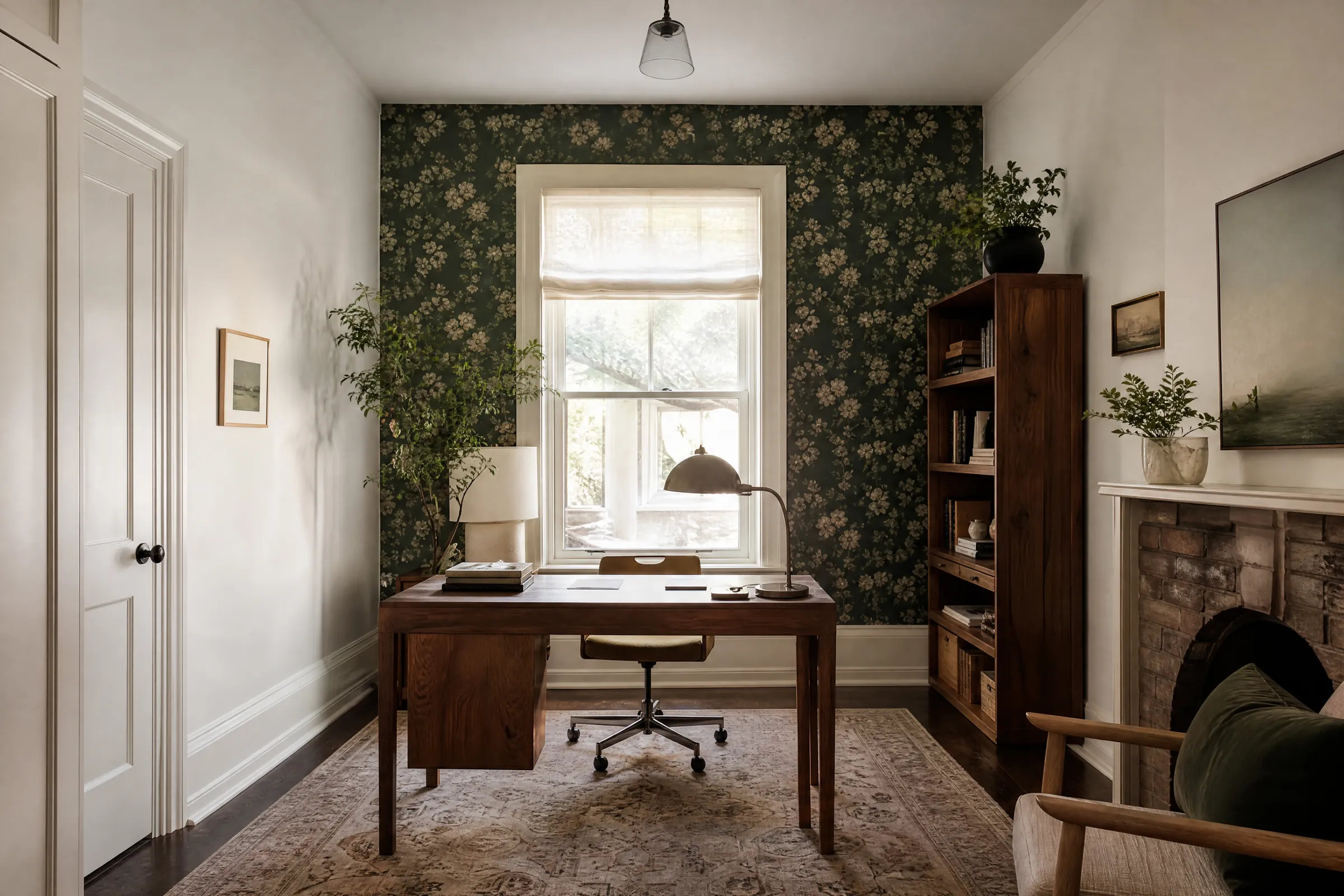
The previous owner had covered the den’s main wall in a grey, grass-textured peel-and-stick paper, a self-adhesive vinyl sold as easy to put up and take down. The new owner wanted something more considered: a sage green paper with an art deco fan pattern on that wall, with a wood chair and a large plant in front of it, and the rest of the den painted to suit.
Peel-and-stick that did not peel cleanly
Peel-and-stick paper is meant to come off without damage, and on a wall with a durable, well-cured paint underneath it often does. Here, it had gone onto thin builder paint. Over time, the seams had shrunk apart, leaving thin stripes of white wall showing between panels, and the corners had curled. When we lifted a test corner, the adhesive had bonded more strongly to the paint than the paint was bonded to the drywall, so a strip of white paint came away on the back of the vinyl, and in places the drywall’s paper face came with it.
The wall also still held a TV bracket the previous owner had mounted through the vinyl, leaving bolt holes once it came down, and a scatter of small holes from picture hooks.
Condo conditions shaped the work
- As condo buildings typically require, the service elevator was booked in advance for each delivery and removal.
- Condo buildings usually limit noisy work to set weekday hours, so scraping and sanding were planned within them.
- Corridors and the suite entrance had to be protected, and all waste carried out, not put down the garbage chute.
- With the suite’s windows opening only partway, odour and dust needed more thought than in a house.
Arriving and protecting the suite
Before the first visit, we confirmed the hours and elevator rules with management. On each arrival, padded blankets went up in the service elevator, and a runner was laid from the elevator door along the corridor to the suite. Inside, rosin paper went down over the den’s laminate, edges sealed with tape, and a drop cloth path ran from the entry to the den. The den furniture moved to the living room under plastic, and the den doorway was closed with a plastic sheet with a zip opening to contain sanding dust.
Removing the vinyl and its glue
- Warming the adhesive. Rather than pulling the vinyl off cold, which would have taken more paint with it, we warmed each panel gently with a hair dryer on low heat and peeled it back slowly at a low angle, close to the wall. Warm adhesive lets go more readily.
- Cleaning residue. Some sticky residue stayed on the wall. We wiped it off with an adhesive remover that is safe on painted drywall, then washed the wall with mild soap and water and let it dry. Residue left behind would stop the new paper from bonding and could bleed through it.
- Sealing the damage. Where paint had pulled away cleanly, the edges were sanded smooth. Where the drywall’s paper face had torn, the exposed brown layer was sealed with a shellac-based primer so it would not bubble under compound.
- Filling and skimming. The TV bracket and picture holes were filled, and the whole feature wall was given a thin skim coat with lightweight compound to bring the torn spots and the peeled-paint edges level with the rest. After sanding, we raked a work light across the surface to find any ridges.
Sanding was done with a vacuum attachment so fine dust stayed out of the suite’s ventilation and off the furniture next door in the living room.
Priming for wallpaper
Wallpaper needs a surface that grips its paste evenly and lets the paper slide a little while it is positioned. Skimmed compound and old builder paint absorb very differently. A coat of pigmented acrylic wallcovering primer over the whole wall evened that out, and it will also protect the drywall when the paper is taken down in the future, so the next owner does not face a repair like this one.
Hanging the art deco fan paper
This paper was pre-pasted: the paste is already on the back, dry, and is activated with water. Each length was cut with extra at both ends, rolled loosely, dipped in a water tray for the time printed on the roll label, then folded paste to paste and booked so the paste could activate and the paper could relax.
- Centring. The fan pattern has a strong vertical rhythm, so we centred a full column of fans on the wall rather than starting in a corner. That gives matching partial fans at both ends.
- Plumb. A laser line set the first drop. Condo walls are generally straighter than old plaster, but the corner at one end still leaned slightly, so each drop was checked against the line, not the corner.
- Matching. The fans had a straight match, meaning the pattern lines up level across each seam. Each length was held up against the last before it was trimmed at the top so the fans aligned exactly.
- Smoothing and trimming. A soft brush pushed air out of each drop, working outward from its middle, seams were pressed lightly with a roller, and the excess was trimmed at the ceiling and the baseboard using a broad knife and a fresh blade for every cut. Paste was sponged off the face, the ceiling line and the baseboard top as each drop went up.
Painting the rest of the den
The remaining den walls were filled where needed, spot primed, and given two coats of a low-odour eggshell. Edges were brushed along the ceiling and the new paper, which was masked with a low-tack tape only once it was fully dry, and the walls were rolled. The second coat waited out the manufacturer’s recoat time. The closet door, a flat slab, was lightly sanded and finished in a pair of semi-gloss coats from a fine foam roller. Low-odour paint was the clear choice in a suite with limited window opening.
A colour to sit beside sage
A soft sage green with fan motifs is warm and quietly retro, and plain white walls next to it looked cold. We painted sample pots of a few warm whites and a pale putty on the wall opposite the paper, and the owner looked at them in the strong morning glare off the lake and again after sunset by lamplight. The pale putty won: it picks up the warmth of the wood chair and floors and lets the sage paper read as the room’s one strong surface.
Leaving the suite and corridor tidy
Each day’s waste was bagged, carried down in the service elevator and taken away, the corridor runner was lifted and the hallway checked for marks, and the suite was vacuumed. The den’s plastic sheet stayed up until the last coat was done.
The den now has one wall of sage green fans running edge to edge, crisp at the ceiling and the baseboard, with putty walls and a clean white closet door around it.
Looking after the wall
- Most pre-pasted papers can be wiped gently with a damp, well-wrung sponge. Do not use cleaning sprays.
- Use proper picture hooks rather than adhesive strips on the paper; strips can lift the paper face when removed.
- Offcuts, the roll label with the batch number and a labelled can of the wall colour were left in the den closet.
- If a seam ever lifts, it can be reglued with a seam adhesive; call us if more than a short section lifts.
Why condo wallpaper work in Etobicoke is planned this way
Towers along the lakeshore in Etobicoke come with rules about elevators, hours and waste, and suites with walls finished in thin builder paint. Removing old paper, especially self-adhesive types, has to be done gently, and new paper needs a properly primed wall. Planning our wallpaper installation around the building’s rules and the wall’s real condition gives a clean result without trouble in the corridors. We have been painting and papering homes as painters across Toronto since 2010, condo suites included.
If your suite has a wall you want papered, or old paper you want gone, send us your building details and we will plan the visit around your management’s rules and send an itemized quote.