
If your backyard fence has faded to a dull grey, is showing splinters, or looks weathered next to a freshly landscaped yard, professional fence staining toronto is one of the highest-value exterior upgrades you can make this summer. A quality stain does far more than restore colour. It seals wood against the swings between humid GTA summers and freeze-thaw winters, blocks the UV rays that bleach cedar and pressure-treated lumber, and stops the moisture intrusion that leads to warping, cupping and rot. At All Painting, we have spent years staining fences, decks and other outdoor woodwork across Toronto and the surrounding suburbs, and this guide walks you through everything you need to know about costs, the best stains, timing and prep so your fence looks sharp and stays protected for years.
Whether you own a Victorian semi in Leslieville with a short cedar privacy fence, a detached home in Etobicoke bordered by a long run of pressure-treated pickets, or a townhouse in Vaughan with a shared property-line fence, the fundamentals of good fence staining toronto work are the same. It comes down to correct preparation, the right product for your wood and exposure, and applying it at the right time of year. Get those three things right and your fence will resist the harsh Ontario climate; get them wrong and you will be re-doing the job in a season or two.
Why Fence Staining Toronto Homeowners Should Not Skip This Job
Wood left unprotected in the Greater Toronto Area takes a beating. Between the intense July and August sun, summer thunderstorms, autumn leaf moisture, and the punishing freeze-thaw cycles that follow, an unstained fence can begin to grey within a single season and show serious deterioration within two to three years. This is exactly why fence staining toronto is not a cosmetic afterthought but a genuine maintenance investment that protects the money you already spent on the fence itself.
A new cedar or pressure-treated fence is a significant expense, often running thousands of dollars for a full backyard perimeter. Staining protects that investment the same way exterior paint protects your siding. The stain penetrates the wood fibres and forms a water-repellent barrier, while pigments act like sunscreen against UV damage. Homeowners who stain proactively typically get 15 to 20 years out of a fence, while those who leave it bare often replace boards or entire sections far sooner. Beyond protection, a crisp, evenly stained fence dramatically lifts your home’s curb appeal, which matters whether you are planning to sell or simply want your outdoor space to feel finished. Many clients pair fence work with our deck and fence staining service so the whole backyard reads as one cohesive, well-kept space.
Best Time of Year for Fence Staining in the GTA
Timing is one of the most overlooked factors in a durable finish. Stain needs dry wood and moderate, stable temperatures to cure properly, which makes late spring through early autumn the ideal window across the GTA. Right now, in the heart of a Toronto summer, conditions are close to perfect, provided you plan around the weather and the wood’s moisture content.
The wood should be dry to the touch and ideally have gone at least 24 to 48 hours without rain. Direct blazing sun on a 32-degree afternoon is actually not ideal, because stain that flashes off too quickly can dry before it penetrates, leaving lap marks and uneven absorption. We prefer to work in the morning or on mildly overcast summer days when temperatures sit between roughly 15 and 27 degrees, with humidity that is not excessive. For brand-new pressure-treated fences, patience matters most of all: the lumber often arrives saturated with treatment chemicals and moisture and may need several weeks to a few months of drying before it will accept stain.
| Season in the GTA | Suitability for Staining | What to Watch For |
|---|---|---|
| Late spring (May–June) | Excellent | Watch for lingering spring rain; confirm wood is fully dry |
| Summer (July–Aug) | Excellent | Avoid staining in peak afternoon heat and direct blazing sun |
| Early autumn (Sept–Oct) | Very good | Cooler nights slow curing; stain earlier in the day |
| New pressure-treated wood | Wait first | Allow several weeks to months to dry before staining |
Because the warm-season window is limited, booking early is wise. Summer is peak demand for outdoor staining across Toronto, Mississauga and Oakville, and the best crews fill their calendars quickly. Reaching out at the start of the season means your fence staining toronto project lands on a suitable stretch of weather rather than being rushed against an autumn deadline.
Choosing the Right Stain: Transparent, Semi-Transparent and Solid
Not all stains are created equal, and the finish you choose has a major impact on both appearance and how often you will need to re-coat. The three broad categories are transparent, semi-transparent and solid, and each has a clear place depending on the condition of your wood and the look you want. During any fence staining toronto consultation, matching the product to your specific fence is the single most important decision we help you make.
Transparent and clear-toned stains show off the natural grain and are beautiful on new, high-quality cedar, but they offer the least UV protection and need re-coating most often. Semi-transparent stains are the sweet spot for most GTA fences: they add rich colour and meaningful UV and water protection while still letting the wood grain show through. Solid or opaque stains behave almost like paint, hiding the grain entirely but delivering the longest-lasting protection and the best coverage for older, weathered or previously painted fences. For fences with a lot of sun exposure or visible age, we usually steer homeowners toward semi-transparent or solid products.
| Stain Type | Look | Protection Level | Typical Re-Coat Interval |
|---|---|---|---|
| Transparent / clear | Natural grain, minimal colour | Lowest | 1–2 years |
| Semi-transparent | Grain visible with added colour | Medium-high | 2–4 years |
| Semi-solid | Grain partly obscured | High | 3–5 years |
| Solid / opaque | Grain hidden, paint-like | Highest | 4–7 years |
Oil-based stains penetrate deeply and are excellent for dense woods, while modern water-based and hybrid formulas offer lower odour, easier cleanup and strong durability. We select premium products suited to Ontario’s climate and your fence’s wood species and condition, and we account for the colour looking slightly different once it cures on real wood versus how it appears on a sample card. The right product choice is what separates a finish that lasts years from one that fails in months.
Our Fence Staining Process, Step by Step
A lasting finish is 80 percent preparation and 20 percent application. Skipping prep is the number one reason DIY fence staining toronto jobs fail early, and it is where our experience pays off most. Here is how a professional job unfolds from start to finish.
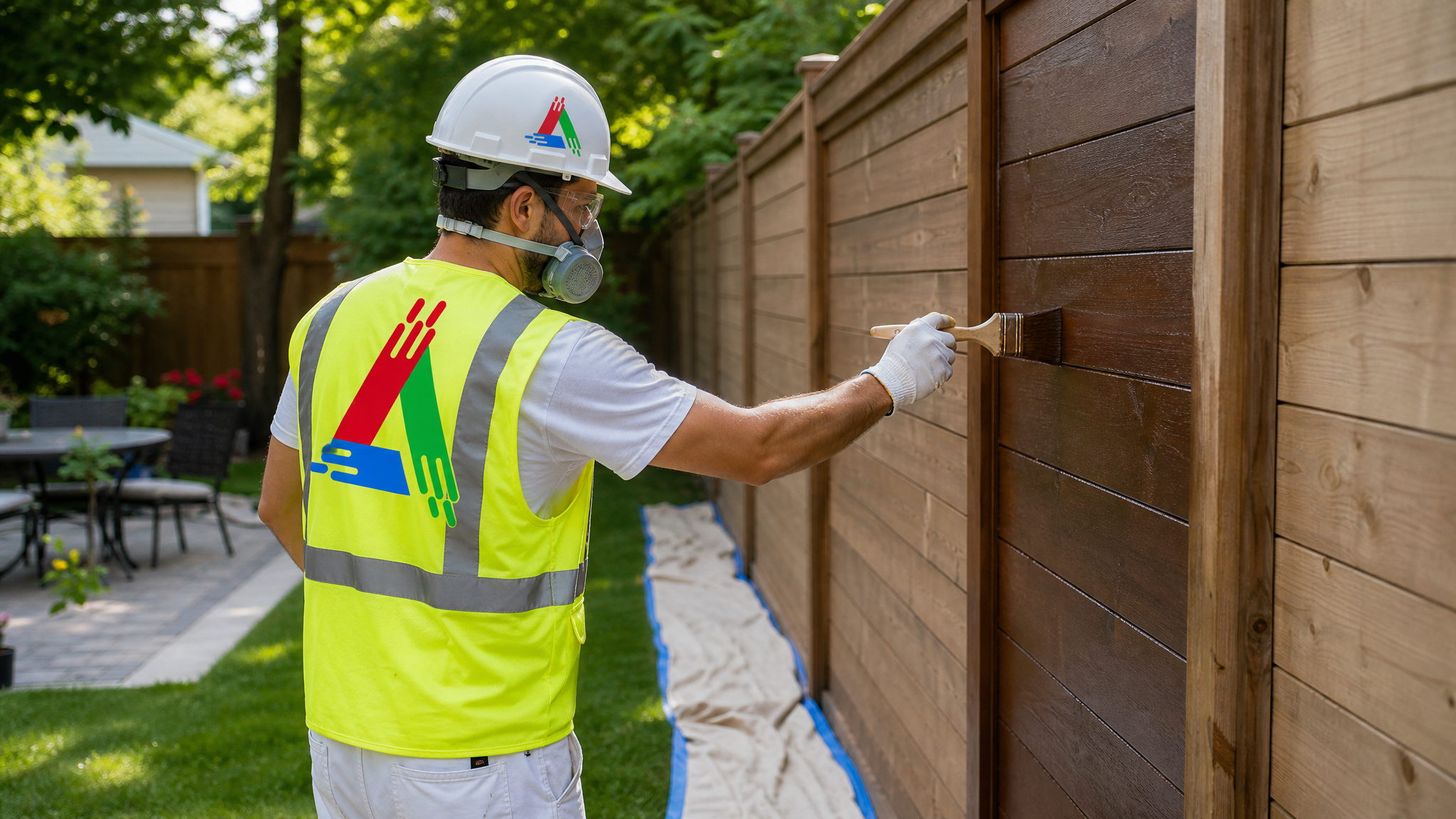
First, we inspect the fence for damage, loose boards, protruding nails and areas of rot, and we flag anything that should be repaired before staining. Next comes thorough cleaning: we remove dirt, mildew, pollen and any old flaking finish, often with a wood-safe cleaner and, where appropriate, careful pressure washing at a controlled pressure that will not gouge the grain. On greyed or previously coated fences, we may brighten or lightly sand the surface to open the wood so the new stain can penetrate. Then we allow full drying time, because applying stain to damp wood is a recipe for peeling.
Only once the wood is clean, sound and dry do we mask off adjacent surfaces, lay down drop sheets to protect patios, gardens and walkways, and begin applying the stain. We work board by board, maintaining a wet edge to avoid lap marks and back-brushing to drive the product into the grain, applying additional coats where the manufacturer and wood porosity call for it. Finally, we clean up completely and inspect every section, ensuring even coverage on posts, rails, pickets and the often-neglected tops and bottoms of boards where water intrusion usually begins. Homeowners who value this level of care for their fences frequently also trust us with their exterior painting and house painting projects.
How Much Does Fence Staining Cost in Toronto in 2026?
Cost is understandably one of the first questions homeowners ask, and the honest answer is that fence staining toronto pricing depends on several factors: the total linear footage and height of the fence, whether one side or both sides are being stained, the condition of the wood, how much prep and repair is required, and the type of stain selected. Solid stains and heavily weathered fences that need extensive cleaning and sanding will sit at the higher end.
As a general guide for 2026, professional fence staining in the GTA is often priced per linear foot or per square foot of surface area. The figures below are typical ranges to help you budget; an on-site assessment gives you an exact quote tailored to your fence.
| Project Scope | Typical 2026 Range (CAD) | Notes |
|---|---|---|
| Per linear foot (one side) | $8 – $16 / linear ft | Standard height, good condition wood |
| Per linear foot (both sides) | $14 – $28 / linear ft | Full privacy fences, both faces |
| Small backyard fence | $700 – $1,600 | Short runs, minimal prep |
| Large or corner-lot perimeter | $2,500 – $5,500+ | Long runs, heavy prep, solid stain |
| Extra weathered / repair prep | +15% – 30% | Cleaning, sanding, board repairs |
It is worth remembering that a professional job is not simply a labour charge. It includes premium stain, the right equipment, thorough preparation, protection of your property and, crucially, a finish that lasts years longer than a rushed DIY attempt. Spending a little more on quality fence staining toronto work almost always costs less over the life of the fence than repeatedly re-coating a poorly prepared surface or replacing boards that failed for lack of protection. Homeowners in nearby cities can budget similarly with our Mississauga painters and Oakville painters teams.
Preparing Your Fence and Keeping It Protected
Even after a professional stain, a little ongoing care extends the life of the finish considerably. Keep climbing plants, sprinklers and piled soil or mulch away from the base of the fence, since constant moisture at ground level is where rot most often starts. Rinse off pollen, dust and cobwebs a couple of times a season, and address any mildew spots promptly before they spread. Every year, take a quick walk along the fence line and look for areas where the stain is beginning to fade or wear, particularly on the sun-facing side and the horizontal top rails that catch the most weather.
When you notice colour fading or water no longer beading on the surface, it is time to plan a re-coat. Semi-transparent finishes generally signal this every few years, and staying ahead of it means a simple maintenance coat rather than a full strip-and-restore. The schedule below gives a realistic maintenance rhythm for GTA fences.
| Interval | Recommended Care | Why It Matters |
|---|---|---|
| Every season | Rinse debris, check for mildew | Prevents buildup and staining of the finish |
| Annually | Inspect sun-facing side and top rails | Catches early fading before it spreads |
| Every 2–4 years | Apply a maintenance coat (semi-transparent) | Restores UV and water protection |
| Every 4–7 years | Recoat solid-stain fences | Longer-lasting finishes need less frequent work |
| As needed | Repair or replace damaged boards | Stops localized rot from spreading |
Why Choose All Painting for Fence Staining Toronto Projects
Fence staining looks simple until you are the one balancing product choice, weather windows, wood moisture, prep and even application across dozens of boards. Small mistakes such as staining damp wood, over-thinning product, or working in the blazing afternoon sun lead to peeling, lap marks and premature failure. Our crews handle the entire process so you get a clean, even, durable finish without the weekend of labour and the risk of getting it wrong.
All Painting is a full-service GTA painting company, which means we can coordinate your fence work alongside other exterior and interior projects. Many clients who book fence staining toronto service also ask about our interior painting and staircase painting and staining, or read through our customer reviews before deciding. Whatever the scope, we bring the same attention to preparation and detail that makes a finish last. To learn more about our team and standards, visit our about us page.
How long does fence staining toronto work take to complete?
Is summer a good time for fence staining toronto homeowners?
Should I stain or paint my fence?
How often should a stained fence be re-coated in the GTA?
Can you stain a brand-new pressure-treated fence right away?
How much does professional fence staining cost in Toronto?
Book Your Fence Staining Toronto Project Today
Protect your investment and refresh your outdoor space with expert care from All Painting. Our crews handle everything from prep and cleaning to premium stain application, so your fence looks its best and stands up to Ontario’s climate for years to come. Summer is the perfect season to get it done, and our calendar fills quickly.
Call us today at (416) 710-4224 or request a free quote to get started.
All Painting proudly serves Toronto, Mississauga, Oakville, Markham, Burlington, Hamilton, Richmond Hill and the GTA.